0
0

In the beginning of the 20th century, as Karachi blossomed into a scenic littoral region and its demographics began to change bit by bit, residential areas were developed in those parts of the city where there was room for constructing new houses. As a result, some very well-planned colonies came into being. One of them was Cincinnatus Town.
Cincinnatus Town was named after Cincinnatus Fabian D’Abreo, a kind-hearted gentleman who significantly contributed both to the well-being of his community and to beautifying Karachi’s landscape. The locality later came to be known as Garden East and Garden West. Different people give different reasons for that, one of which is the emergence of Gandhi Garden (now Zoological Garden) in the area. The Garden vicinity, before the partition of the subcontinent, used to be clean-as-a-whistle part of the city. But if anyone who had seen Garden in the 1940s and intends to visit the area today should be prepared for the shock of his life.
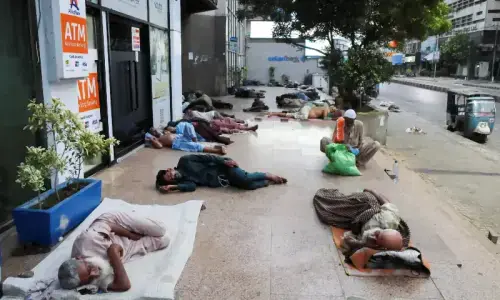
These days Garden’s population has risen into hundreds of thousands. A big chunk of it is stuffed with countless slapdash works of construction (apartment blocks, houses and markets). It is no mean feat entering the neighbourhood from the Zoological Garden’s side after crossing Lawrence Road (now Nishtar Road). In weekdays, especially during the day, the traffic flow is painfully sluggish as gridlock has become part of the residents’ daily routine.
Discounting those that stand on Nishtar Road, the colonial buildings that were once the hallmark of this vicinity have all but disappeared. There’s a smattering of pre-partition structures in Garden East whereas Garden West has transformed into a concrete jungle. If you wish to see what contemporary Karachi neighbourhoods looks like, Garden West would be one of the pertinent examples. So if you’re to look for an old stone made work of architecture in Garden West, you would require a fair amount of luck to chance upon one. But as they say, where there’s a will, there’s a way.
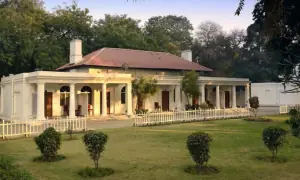
Visiting Garden West after a brief stay at the Zoological Garden is an interesting journey. Moving alongside a huge stone building to enter the area immediately gives you the indication as if it’s chock-a-block with colonial pieces. There is a residence, large one at that, right next to the huge structure. Its front portion cannot be seen clearly because of the rather well-erected boundary wall. However, the bungalow next to it is an intriguing sight. It is vacant and is property of a wakf. Even a cursory look at the work of stonemasonry is enough to realise what a marvellous building it is. Perhaps it’s the lack of occupancy that has caused it to deteriorate, but the sturdy pillars and an imposing façade make it a work of art.
There is another house opposite the aforementioned bungalow. It is also quite old but not old enough to be discussed in the same breath. Besides, the pinkish hue on its façade suggests people who own it are working on its restoration.
From here begins the troublesome part of the journey because other than these residences Garden West offers nothing in terms of yesteryear architectural glory. Hold on. Don’t lose hope. You have to walk at least 15 minutes, that is, you go straight and turn left into Ghulam Husain Qasim Road, to witness a veiled beauty.
Ghulam Husain Qasim Road is dotted with flats. Rows and rows of blocks might give you the idea that there is no way in the world that a classically built edifice could be found in this nook of the city. Wrong. Nestled, well not nestled, still breathing amidst strangers of sorts, is a remarkable bungalow on whose right side a school signboard hangs aimlessly. You harbour the notion that it’s a school building. You can’t be sure, because at present it is as empty as a tyrant’s heart.
My word, it is some work of colonial architecture (ignore the cracked, demolished and battered parts of it). The buildings has many noticeable features, foremost of which are the Ionic columns that are integral to its design. The windows are embellished with delicate motifs. A young man suggests pretty soon a school is going to be shifted here.
By the way, opposite this work of art is another oldie. However, it is not worth mentioning as far as its architectural features are concerned.
Architect Arif Hasan says: “Garden West was part of Cincinnatus Town just like Garden East. There were a lot of bungalows in this area. They had classical elements, though they were not strictly classical buildings. I have no idea as to why Garden East gets a fair mention in research works and not Garden West.”
A garden needs attention on a daily basis. It all boils down to how much you care about your plants and trees that keeps it green and fresh. Sadly, the plants that Cincinnatus Fabian D’Abreo grew in his Garden have shrivelled. And nothing can be done about them, or so it seems.