0
0

UMERKOT, Feb 19: It was hard for him to fight addiction to narcotics, which had blocked his veins, as he felt dejected after being unable to marry a girl he loved, yet he managed not only to give up drugs but also began counselling others in an attempt to save them from contracting HIV that he luckily did not get infected with all these years.
This is the story of Ghulam Mustafa Pathan, a Sanghar city resident who graduated from Allama Iqbal Open University and served the Anti-Narcotics Force as an intelligence constable at the Karachi port before resigning from the service in 2004 to move back to his native town where he had found his love a year ago.
Feeling piqued after failing to marry her, he began smoking hashish to stop thinking about it. But it did not help him for long, causing him to go for other means. He later joined an insurance company to keep himself busy but that too prove futile. Finally, he started taking whisky and opium to comfort his mind and get some sleep. It too proved short-lived as in 2006 he began injecting drugs, commonly available at medical stores, which are given by anaesthetists to their patients before surgery. When it became difficult for him to find any vein that could be pricked, he started drinking the injectable drug and inhaling heroin. In 2009, his addiction resulted in paralysing the left half of his body, but he continued with the drugs.
It was in 2010 when his daughter, Noor Fatima, was born that he questioned himself as to what would be the future of the innocent girl if he died or kept taking drugs. On that very day he decided to fight his addiction to alcohol and drugs.
While thinking about the future of his daughter, it was his will that he started recovering on his own without the help of any medical treatment.
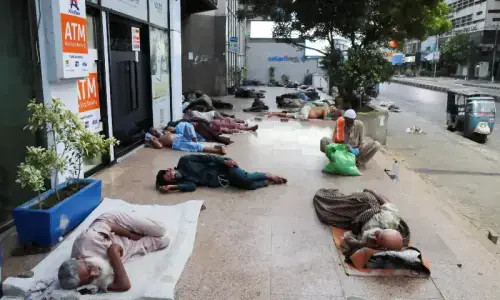
HIV positive But Ghulam Mustafa Pathan is not the only one who got addicted to narcotics. There are hundreds of people in Sanghar who continued to face the same problem. He was lucky that he remained safe from HIV/Aids but on the streets, of the 907 injection drug users (IDU), 105 were found HIV/Aids positive, including six in Sanghar, 46 in Shahdadpur and 50 in Tando Adam, said Ali Sher Dahiri, the district administrator of the Bridge Consultants Foundation.
Now Ghulam Mustafa offers counselling to his fellow drug addicts, citing to them his own example. So far he has helped 12 of them in fighting their addiction to narcotics.
Mr Dahiri said the foundation had registered the IDUs in the streets but the actual number could be alarming if white-collar drug users and sex workers in the district were screened.
He said that during three months, seven of the 105 HIV positive persons had died. He said the foundation in collaboration with the Sindh Aids Control Programme had started counselling, awareness sessions and screening of IDUs and their spouses.
He added they provided them new syringes on a daily basis to avoid re-use because sharing of syringe was a cause of HIV/Aids spread among IDUs.
Those who expressed their will for anti-retroviral therapy (ART) were referred to Centre for Healthful Behaviour Change (CHBC) in Karachi, he added. The CHBC develops, implements and disseminates innovative evidence-based behavioural interventions in routine clinical practices and community-based settings. But, according to Mr Dahiri, drug addicts usually do not intend to go for therapy.
The foundation also provides health services to drug addicts on the spot. For their hygiene, a barber has been hired to trim their hair, shave and help them take bath. They have also started counselling with their spouses to persuade them to use contraceptives to avoid transfer of the virus.
He told this reporter that a social worker in their Sanghar office, who had not been a drug user, fell victim to the virus while collecting injections from drug users when one of them threw a syringe at him. “It shocked us all,” he said. This young man had lost hopes, but was rushed to Karachi for treatment where he was getting ART and they hoped that he would be declared HIV negative.
Cases on the rise According to Sharaf Ali Shah, executive director of the foundation, the number of drug addicts is increasing alarmingly.
He said that people fell victim to drugs because of stress, depression, poverty, unemployment, social behaviours, family circumstances, unresolved problems, injustice and failure in love.
Once they get addicted, they steal, sell their blood or beg to buy drugs, according to him.
He said it was due to lack of rehabilitation centres in the province that the disease was spreading fast. Many district headquarter hospitals did not have HIV screening kits, he said, while suggesting that jails and brothels were needed to be screened.
Use of unhygienic instruments and equipment in operating theatres, dental clinics and barber shops as well as unsafe transfusion of blood and sex with affected persons are major causes of the spread of the disease, according to him.
A source in the Umekot district hospital told Dawn that no programme on prevention, cure, detection and registration and awareness regarding HIV/Aids was running in the district.
He said that more than 40 private laboratories were being run in the district and none of them had HIV/Aids screening kits. Even their tools were not sterilised, the source added.
He said that only the pathology laboratory of Umerkot Taluka hospital had HIV/Aids screening kits, which were used at the time of blood transfusion or when a case was referred to it, but mostly people did not find it important to get themselves examined.
Dr Munawar, media coordinator of the Sindh HIV/Aids Prevention and Control Programme, told Dawn that 5,508 HIV/Aids positive cases were recorded between 2004 and 2012. They included eight in Badin, 12 in Mirpurkhas, 4009 in Karachi, 357 in Larkana and 105 in Sanghar, he added.