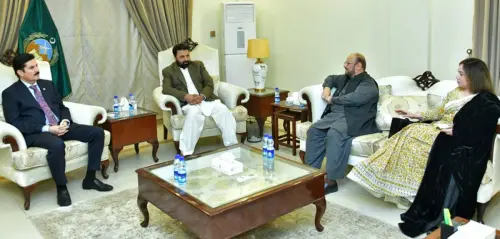
ISLAMABAD, Nov 16: With 70,000 children in capital are still out of school, implementing Right to Free and Compulsory Education Bill 2012 for Islamabad, passed by National Assembly and Senate recently, seems to be a big challenge.This was stated by the participants at a function held here on Friday to celebrate the passage of the bill.
National Assembly unanimously passed the bill moved by MNA Yasmeen Rehman on November 13.
The bill has made it mandatory for the government to provide free education to all children of the age of 5 to 16 years.
The bill also ensures 10 per cent quota in all the private educational institutions has to be reserved for poor children.
Besides, parents will have to pay a penalty up to Rs50,000 or undergo six months imprisonment if they fail to enroll their children in school.
Speaking on the occasion, the architect of the bill MNA Yasmeen Rehman said credit for the passage of the bill also went to senator SM Zafar. She said government showed commitment and United Nations agencies also supported.
However, she refused to give a timeframe for the implementation of the bill all over the country.
“This bill is only for the Islamabad but I am sure that similar bills will be passed by assemblies of all the provinces. In fact officials of Sindh government have contacted me because they also want to table a bill ‘Education for All’,” she said.
“Both girls and boys should have equal chance of education. If we have educated mothers, we will get educated nation.
Education can also root out terrorism,” she said.
MNA Pervez Khan of ANP promised that he would recommend to his party’s government in Khyber Pakhtunkhwa to table a similar bill in the assembly.
“In my province, 760 schools have been demolished and students are sitting on debris. Government is committed to educating every child,” he said.
Senator Saeeda Iqbal of PPP said children between the age of 5 and 16 would now be admitted to the schools.Secretary Ministry of Capital Administration and Development (CAD) Rifat Shaheen Qazi said that her ministry had started preparing roadmap for admitting all the children into schools. She expressed the hope that the President would soon sign the bill into law.
“We need a lot of resources, and we hope that UN agencies and donor organisations will help us to achieve the target. Other than financial assistance we also need community and media support. Government is committed to increasing literacy rate,” she said.
Dr. Kozue Kay Nagata, Unesco country director said: “The passing of the bill itself is a historic milestone towards education for all in Pakistan. What matters is not only the result but also its process that was fully participatory and consultative involving politicians of all parties, civil society and other stakeholders. The process demonstrated how an all-party consensus could be built through a democratic and participatory approach to addressing an issue of national importance.
“Here I would like to underscore that the bill was not initiated or formulated with the routine bureaucratic process. This legislation is unique in the sense that it has been initiated by people’s representatives supported by all political parties.”