0
0

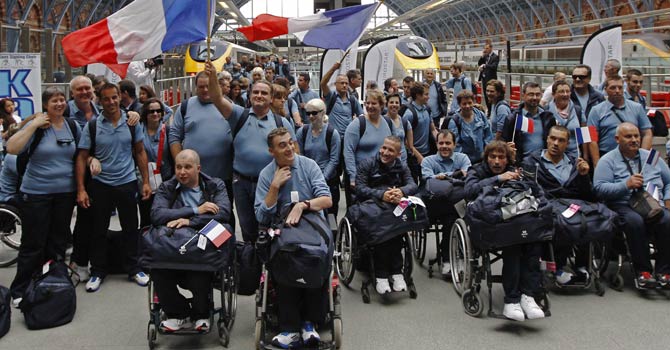
LONDON: To ensure there is no cheating at the Paralympics, officials will be testing not just for the usual banned drugs, but for a practice called boosting, where wheelchair athletes do things like break a toe to cause a blood pressure spike to enhance performance.
In able-bodied athletes, intense physical exercise automatically raises the heart rate and blood pressure. Athletes with a severe spinal cord injury, however, don't get that natural boost.
To get a rapid rise in blood pressure, wheelchair-bound athletes may resort to another solution: inducing a state called autonomic dysreflexia. That is a reflex that occurs when the lower part of their body is exposed to painful stimuli, like filling the bladder to capacity, using tight leg straps, or sitting on a sharp object. This elevated blood pressure can cause a heart attack or stroke but since the athletes can't feel it, some think the risk is worth taking.
Studies have shown athletes with a spinal cord injury who boost can get up to a 10 percent improvement in some races.
''It's an extreme thing to do and we have to constantly remind athletes it's very dangerous,'' said Craig Spence, a spokesman for the International Paralympic Committee.
The IPC banned the practice in 2004 and says it doesn't have evidence boosting is widespread. At the Beijing Paralympics, 37 athletes competing in events thought to be at high risk of boosting were tested. None were positive.
According to a report by the World Anti-Doping Agency, about 10 out of 60 athletes surveyed at the Beijing Paralympics admitted having boosted at a major competition.
Spence said there are only about 100 athletes at the upcoming Paralympics who would benefit from boosting, given their disability and their event. ''At the end of the day, it's only a handful of athletes who are actually self-harming,'' he said.
Spence added that the IPC would conduct blanket testing in sports where athletes might be tempted to boost at the upcoming Games and officials would also examine athletes with symptoms of boosting, like having a red face or sweating before the race.
Athletes found to have high blood pressure will be asked to wait about 10 minutes before being tested again. If their second test is the same, they won't be allowed to race for health reasons.
''There's a limit to how we can test for this,'' Spence said. ''We can't really ask people to drop their trousers so we can check there's nothing unusual in there,'' he said, noting they have found competitors who stuck pins into their testicles to get the desired effect.
Spence said those suspected of boosting are not penalized in the same way as those caught doping. ''Their punishment is they can't compete unless they have a doctor's certificate to explain why their blood pressure is high.''
Some experts have said paralyzed athletes may simply accept the health risks of boosting as a necessary cost of victory. ''These athletes don't feel the pain of the injury and the pursuit of elite sport is in some ways already unhealthy,'' said David James, a senior sports engineer at Sheffield Hallam University.
''We accept harm in all sorts of sports, like boxing,'' James said. ''They may think this is just another form of that,'' he said.
Others said we shouldn't expect Paralympic athletes to behave any differently than athletes in any other elite sport.
''To assume people in Paralympic sport won't engage in whatever way they can to get an advantage is to put them on a pedestal,'' said David Howe, a senior lecturer at the School of Sport, Exercise and Health Sciences at Britain's Loughborough University. ''Just because somebody has an impairment doesn't mean they're a virtuous person.''