20
20


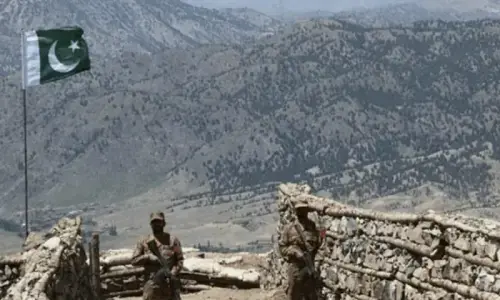
PESHAWAR, Aug 7: Army has become a permanent stakeholder in the Federally Administered Tribal Areas’ development sector as its recommended development projects are executed every year with Fata’s development funds, according to official sources.
Development projects worth millions of rupees are executed every year in Fata on the recommendations of military authorities posted in Fata, officials told Dawn on Tuesday.
“Army officers concerned frequently visit the Governor House and Fata Secretariat to get their proposed community uplift projects for various tribal areas covered under the Fata ADP,” a knowledgeable official said.
A good number of small development projects, including reconstruction of roads, water supply schemes, sewerage and other community welfare schemes, are provided funding on the recommendation of the military authorities, the sources said.
Apart from small schemes the army has also got ADP funding for some major initiatives, including establishment of a couple of technical institutes and rehabilitation centres for militants in Fata. These projects, said an official, involved millions of rupees investment which the army got from Fata’s regular ADP.
However, such development projects, said the official, had been a pain in the neck for civilian authorities because they caused fiscal complications, and distortions in the ADP. Many a scheme, according to the officials, are channelised through the Governor House from where Fata Secretariat is instructed to provide funds for the army’s recommended schemes.
“When they say provide funds for the 40 Division’s projects, no one can deviate,” said an official, adding these projects were launched as ‘non-ADP’ schemes and executed by providing fund from the regular ADP resources.
Officials said that in principle there should be no non-ADP projects. These schemes, they added, left serious implications for the regular ADP as changes had to be made in the ADP funding plan, diverting money from regular development projects to non-ADP schemes.
An official explained that non-ADP projects launched in financial year 2011-12 were executed by diverting funds from the ADP for that year. However, those schemes were reflected in the next financial year’s ADP as ongoing activities, bringing them under the ambit of development programme.
In one such instance, the establishment of Cadet College at Wana, South Waziristan, had been carried out at a cost of Rs185 million. The money was extended as ‘grant-in-aid’ to Headquarter 9 division on the governor’s directives. The project spent almost 100 per cent of the approved funding by June 30, 2012, and a fraction of the approved funding would be provided under the new financial year’s ADP.
Similarly, according to a source, in another instance a Rs145 million ‘grant-in-aid’ has been given to headquarter 40 division for establishing a Cadet College at Sararogha, South Waziristan.
In this case, too, a substantial amount of the approved funding was spent by June 30, 2012, and the remaining sum would be provided under the current financial year’s ADP, said an official.
Officials said that provision of funds to the army’s projects had been causing dismay among the elected representatives from Fata. Since money is provided from the regular ADP this usually leads to negatively affect the elected representatives’ development projects in their constituencies.
“Fata members of the National Assembly and Senate complain that they use their political influence to get funds released from the federal government for development works in their areas, but at the end a substantial amount of those funds are spent on development activities run by army,” said an official.
Army’s involvement in the development sector has also not being taken well by the civilian authorities. Officials said that projects proposed by the military authorities were planned without taking input from the official planners of the federal government.
Since money has to be provided from the ADP funds, it causes alterations under the federal government’s development strategy for Fata, thinning out the development funds among hundreds of development projects executed under the ADP.