0
0

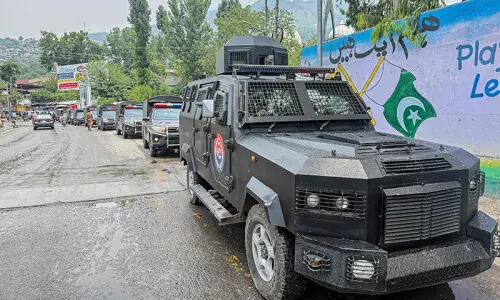
Although the Islamabad High Court (IHC) has taken serious notice of the road blockades in the federal capital, authorities concerned are seemingly helpless in implementing the court’s order.
It is quite obvious that those who have constructed these road blockades in the name of security are far more powerful than the local administration responsible for carrying out the court’s decisions. In the past, the Senate’s standing committee on interior had taken up the issue many times but the barriers remained intact.
The police had upped the numbers of barricades in the inner areas of the city after the tragic assassination of Shahbaz Bhatti outside his residence in Sector I-8 in March 2011. According to a report prepared by the capital police, there are 115 barriers in different areas of the capital.
Furthermore, roads have been completely blocked at no less than 10 points. These points are mainly located next to offices of foreign missions and important government installations, such as the buildings of Inter Services Intelligence (ISI) and the Federal Investigation Agency (FIA).
Four days back, Justice Shaukat Aziz Siddiqui of the IHC issued orders to the chief commissioner, deputy commissioner, inspector general of police, director general passport and DG FIA to submit their comments on a petition seeking removal of barriers from busy thoroughfares. The petition had stated that such closures had created hindrances in the flow of traffic and caused agony to city- wellers, commuters and people coming from other areas of the country.
The court was informed that there were three checkposts on Margalla Road, two each on Kashmir Highway and Blue Area, one checkpost each on Club Road and PTV Chowk, while the road leading on from D-Chowk was completely shut.
Moreover, the roads in front of the Telecom Foundation Complex and Serena Hotel and all roads linking in to the Directorate General Passport Office and DG FIA office had been cordoned off.
Interestingly, the petitioner did not mention the blockade of Soharwardy Road by the ISI and some foreign missions and international organisations.
A senior official of the local administration said as per the court’s orders, notices were being sent to the concerned departments and organisations. “First we will ask them to remove road barricades on their own and in case of non-compliance of the court’s order these hurdles will be removed forcibly,” he said.
On the other hand, there are many who believe that it is next to impossible for the local administration to take any action against powerful departments.
“I think interior minister Rehman Malik is responsible for the whole mess because he believed that terrorism could only be controlled by blocking roads,” said a citizen Riaz Ahmed.
He said if necessary, such blockades and checkposts should only be at entrance and exit points of Islamabad and not in internal parts of the federal capital.
Indeed, the dozens of blockades have affected travel with increased commuting times and consumption of extra fuel. It is also feared that clusters of vehicles at barricades could become soft targets for terrorists.
A senior office-bearer of Islamabad Citizens` Committee, Khalil Sufi, said allowing vehicles to cross one by one through these barriers, especially in the peak hours (morning and office closing time), was extremely inconvenient. He said police were supposed to facilitate the citizens but despite checkpoints all over Islamabad, car thefts and other crimes have increased by every passing day.
“Security departments should adopt latest technology instead of deploying the police on roads,” Mr Sufi opined.