0
0

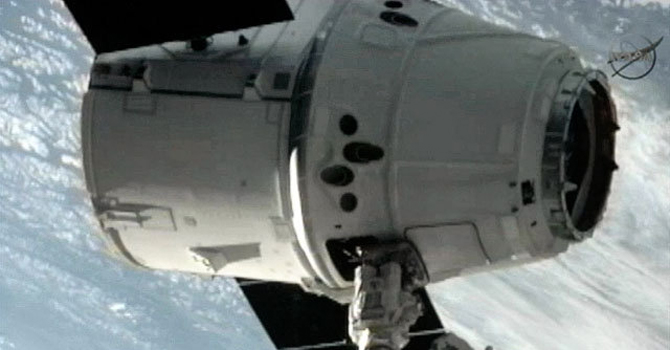
WASHINGTON: US company SpaceX's cargo vessel Thursday splash landed in the Pacific Ocean, capping a successful mission to the International Space Station and blazing a new path for private spaceflight.
“Splashdown successful!!” SpaceX chief executive Elon Musk said in a message on the microblogging site Twitter after the unmanned capsule landed in the waters off the Mexican coast at 11:42 am Eastern time (1542 GMT), SpaceX.
Recovery vessels were headed toward the vessel, which drifted down with the aid of three massive red and white parachutes near its target of 560 miles (900 kilometers) off Baja, California, Nasa said.
“Splashdown! SpaceX Dragon capsule safely down in Pacific Ocean -- ending first mission by a commercial company to resupply the ISS,” Nasa said on Twitter.
The safe return of the vessel followed a near flawless mission to deliver cargo to the $100 billion orbiting outpost, marking the first time a commercial outfit has sent its own capsule there and back.
Nasa and US leaders have applauded the mission as a pioneering first step in the future of spaceflight, opening the path for private companies to take cargo and someday astronauts to the ISS.
The end of the three-decade US space shuttle program in 2011 left the United States without a means to reach space on its own, and has forced the world's astronauts to rely on Russia for rides to the ISS and back to Earth.
Japan and Europe also have cargo ships that can reach the space lab but cannot return cargo intact. SpaceX's cargo ship is larger than Russia's Soyuz capsules and is capable of bringing back more gear.
The white Dragon capsule stands 4.4 meters (14.4 feet) high and is 3.66 meters in diameter. It could carry as much as 3,310 kilograms, split between pressurized cargo in the capsule and unpressurized cargo in the trunk.
SpaceX, owned by billionaire Internet entrepreneur Musk, says it aims to begin taking people to the space station by 2015.
SpaceX and its competitor Orbital Sciences Corporation, both of which have received funding from Nasa, will likely become the chief cargo servicers of the space station, which is set to remain operational until 2020, Nasa has said.
SpaceX has a $1.6 billion contract with Nasa to supply the station over the coming years, and Orbital Sciences has a $1.9 billion contract to do the same. Orbital's first test flight is scheduled for later this year.
The cargo ship launched from Cape Canaveral in Florida on May 22 with 521 kilograms (1,148 pounds) of gear for the space lab, including food, supplies, computers, utilities and science experiments and is returning a 660-kilogram load to Earth. After it is recovered in the ocean, the Dragon will then be transported to Texas so that its cargo can be returned to Nasa.