0
0

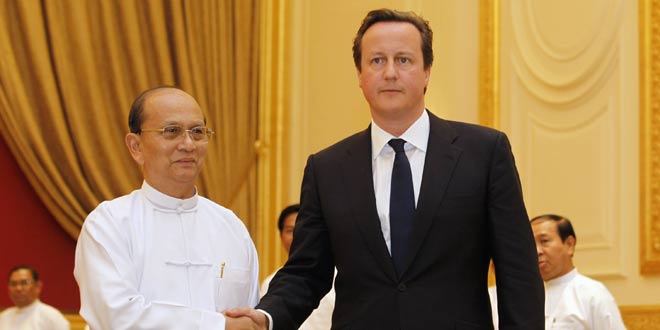
NAYPYIDAW: British Prime Minister David Cameron met Myanmar's president Friday on the first visit in decades by a Western leader to the former pariah state, as world powers consider lifting sanctions.
Former general Thein Sein hailed the summit as “historic” as he welcomed Cameron to his official residence in the regime's showpiece capital Naypyidaw, according to an AFP reporter.
The British premier was also due to meet opposition leader Aung San Suu Kyi in Yangon during the one-day visit, which follows the end of nearly half a century of outright military rule last year.
Britain – Myanmar's former colonial ruler – has traditionally taken a hardline stance on sanctions because of human rights concerns, but it has recently shown signs of softening its position.
“Where reform is beginning, like in Burma, we must get behind it,” Cameron told university students in Jakarta on Thursday during a regional tour that also took him to Japan and Malaysia.
He paid tribute to “the inspirational Aung San Suu Kyi” and praised Thein Sein for moves such as the release of political prisoners and by-elections this month that gave the Nobel Peace laureate her first-ever seat in parliament.
“And let us show that when they have the courage to reform, we have the courage to respond,” Cameron added.
A steady stream of foreign dignitaries, including US Secretary of State Hillary Clinton and British Foreign Secretary William Hague, have visited Myanmar since a new quasi-civilian government took power last year.
But Cameron is the first Western head of government to go there since the military seized power in 1962, ushering in almost half a century of repressive junta rule and isolation from the West.
He is believed to be the first serving British prime minister to visit Myanmar, which won independence in 1948.
After one-to-one talks, Cameron was due to have lunch with Thein Sein, before traveling to the former capital Yangon for talks with Suu Kyi, who spent much of the past 22 years locked up at the hands of the former junta.
The veteran dissident holds huge influence in the United States and Europe, particularly in London, and a move on sanctions would almost certainly need her support.
The 27-nation European Union already lifted some restrictions against the regime this year and foreign ministers will decide the next steps when they meet on April 23.
If Myanmar can persuade Cameron that reforms will continue, the EU could agree to a “substantial relaxation of sanctions,” said Derek Tonkin, a former British ambassador to Thailand and an advocate of engagement with Naypyidaw.
He added, however, that the impact of EU sanctions had been limited and moves to end the stigma of doing business in Myanmar could be more significant.
“I think as far as most people are concerned, they would like the discouragement of trade, investment and tourism – which has been the particular British hallmark – to stop so that it's OK for Standard Chartered, HSBC, Shell and BP and other British companies to go in,” Tonkin said.
In February, the European Union lifted a travel ban on 87 Myanmar officials, including Thein Sein, but kept an assets freeze against them.
Other sanctions include an arms embargo, a ban on gems and an assets freeze on nearly 500 people and 900 entities.
Foreign ministers from the Group of Eight world powers – Britain, Canada, France, Germany, Italy, Japan, Russia and the United States – on Thursday welcomed “significant steps” by Myanmar toward democratic reform.
“The ministers will consider the easing of sanctions to help this country embed reform and fully integrate into international and regional political and economic processes,” they said in a final statement after talks in Washington.
Cameron is accompanied by a group of British corporate executives, but because of the sanctions they are expected to refrain from any business-related activities.