2
2

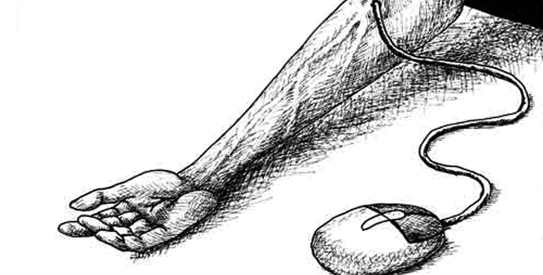
Under normal circumstances, I consider myself pretty blessed. I have a great family, a solid group of friends, two entertaining cats and a job that gives me a free rein to “geek out”. Of course, there are many other things that I am grateful for, like good health and the obvious roti, kapra and makaan; but only recently, I realised that regardless of having all that, there are times when I can be a complete diva. I feel destitute at the lack of things that many people consider luxuries – the internet being one of them.
Last month, my family decided to change homes for the nth time (don’t ask me why), so I took a week off from work, hoping to help out with the packing and what-not. Of course, before we moved into the new house, we all knew that we would have to go a couple of days without the internet. But I confess I had grossly underestimated the situation. When we finally moved to the new place, I could tell that those “couple of days” would soon turn into several days. And unfortunately, with me not at work and no internet at home, I felt like the Mayan prophecy about the world coming to an end in 2012 might hold true for me.
“I can do this!” The first few days were not as difficult as I imagined. I tried to keep myself as occupied as possible – and somewhat succeeded. I barely had time to think about the internet. If anything, the entire time I was congratulating myself for not thinking about the internet (ironic) and for being more physically active in two days than I had been in the two years I had worked at Spider. So there was a lot to celebrate.
By the end of the first two days, I felt like my life was back on track. I had a plan of attack, and all was going well. Drained out of all strength (all that self-celebration wore me out), I knew that even if I had the internet, I was way too tired to go online. So just before I passed out, I smiled to myself thinking, I could totally do this!
Reality bites It was on day three that reality finally set in. You see, I have an Obsessive Compulsive Disorder (OCD); I need instantaneous answers to the most random and trivial questions that pop into my head. Normally, I have the situation under control because I have constant internet at home and in the office. So all the answers are always a click (or a tap) away.
Unfortunately, with the internet out of the equation, I felt purposeless – like one of those bells in the vacuum bell jar experiments, I felt like all the air around me had been pumped out. It may sound like I’m exaggerating, but believe me, the moment I realised that I couldn’t google who the first Pakistani to hit 100,000 followers on Twitter was (Sohaib Athar of OBL-raid fame), I felt physically knocked out.
Honestly speaking, most of the questions that I have are of little significance; and their sole purpose is to satiate my seemingly-abysmal appetite for new information. I can see why people refer to it as an addiction, because just like in the case of any other form of addiction, its absence creates a void in your life. And it’s a void that you’ve created in your mind. It’s unhealthy; its purpose in your life is inflated by your perception of how important it is (when it is actually not that important); and your dependence on it is based on temporary satisfaction. The OCD that I had was just an excuse; my dependence on the internet was insignificant to the bigger picture. I wasn’t using the internet to save the world or rally a protest against a dictator; my motives were petty and self-serving.
Getting a grip About two years ago, I read an article in Wired about internet addiction in China. It was such an intriguing piece of journalism that it stayed with me over the years (those interested in reading it, check out the link: tinyurl.com/WiredAddiction). With a no-nonsense title – ‘Obsessed with the Internet: A tale from China’ – it told the story of 16-year-old Deng Senshan, who was addicted to playing War of Worldcraft – a game that the state media lambasted for leading kids to drop dead or even kill their parents! Worried that they’d lose their son to the addiction, Senshan’s parents enlisted him in a training camp in rural China that promised to rehabilitate internet addicts. In reality, the camp did nothing except terrorise the kids into managing their time better and often used questionable techniques that had unhappy endings. In Senshan’s case, it was death. In case you’re wondering why I’m talking about such a morbid article, it’s because I felt that if my parents learned of my addiction, they’d start scouting for a similar facility in Pakistan (okay, maybe not). But in any case, I had to get a grip.
One incident that convinced me to “rehabilitate myself” was when I found myself begging my little brother for his phone, so that I could use his EDGE (my network provider is extremely expensive and I had maxed out my limit). The sympathetic look he had in his eyes was gut-wrenching. I was better than that.
Baby steps One thing I learned from the entire ordeal was that I shouldn’t take the fact that I have constant access to the internet for granted. I recall being thoroughly amused by a print ad that advocated the internet as a candidate for the Nobel Peace Prize, back in 2010. And when I heard that the United Nations was pushing for internet access to be listed as a human right, I scoffed at the UN’s elite outlook of basic human rights. However, spending a week without the internet put a lot of things in perspective.
I may not be changing the world with the superficial information that I google, but the internet could be life-changing for someone in, let’s say, South Sudan – someone who would make good use of the information he or she finds and the networks s/he creates. I may not be organising a protest against a despotic regime (although, looking at the current state of things, I should), but someone else can; and many already have. So although I’m still not completely cured of my addiction, I think realising that other people make far better use of the internet than I do, helps during withdrawals – just a bit.