0
0


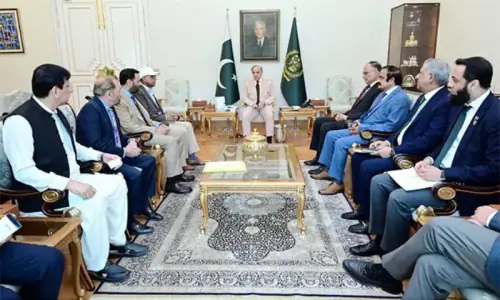
ISLAMABAD: Prime Minister Yousuf Raza Gilani has praised the European Union for securing a waiver on preferential trade package from the World Trade Organisation, allowing import of 75 products duty free from Pakistan to the 27-member European bloc.
The appreciation came at a time when the WTO issued on Friday a detailed report elaborating annual duty free tariff quotas of 22 of total 75 products for a period of two years -- Jan 1, 2012 to Dec 31, 2013.
In a statement issued here on Friday, the prime minister termed the package a success for Pakistan’s economic policies and effective lobbying to help Pakistan, which has rendered innumerable sacrifices for countering extremism and terrorism.
The request for waiver from its WTO obligations was initially made by the EU on Nov 30, 2010. Mr Gilani said the approval of the scheme intended to boost textile exports, which would help Pakistan recover from massive floods in 2010 and the losses it incurred in the war against terror. “Pakistan is thankful to all WTO-member countries for their support and extends gratitude to the EU and its member states for their commitment to help Pakistan revive and stabilise its economy through trade,” the statement added.
According to the WTO report, 20 products on which tariff rate quotas (TRQs) will be applied instead of full liberalisation will be available for 2012 and 2013.
The EU fixed a TRQ of 80,000 tons for duty free import of ethyl alcohol; 361 tons for grain splits of bovine; 361 tons for leather of bovine, including buffalo; 7160 tons for single cotton yarn of combed fibres containing 85pc or more by weight of cotton, measuring less than 232,56 decitex but not less than 192,31 decitex (exceeding 43 metric number but not exceeding 52 metric number), not put up for retail sale.
The TRQ was fixed at 5,105 tons for duty free import of single cotton yarn, of combed fibres, containing 85pc or more by weight of cotton, measuring less than 192,31 decitex but not less than 125 decitex (exceeding 52 metric number but not exceeding 80 metric number), not put up for retail sale.
The EU fixed TRQ of 1,685 tons for import of other dyed woven fabrics of cotton, containing 85pc or more by weight of cotton; 3,002 tons for other dyed woven fabrics of cotton, containing 85pc or more by weight of cotton, weighing more than 200 g/m2; 12,244 tons for yarn (other than sewing thread) of polyester staple fibres, mixed mainly or solely with cotton, not put up for retail sale; 2,275 tons for men’s or boys’ trousers, bib and brace overalls, breeches and shorts (other than swimwear), of cotton, knitted or crocheted; 670 tons for men’s or boys’ nightshirts and pyjamas, of cotton, knitted or crocheted; 1,498 tons for women’s or girls’ nightdresses and pyjamas, of cotton, knitted or crocheted; 614 tons for babies’ garments and clothing accessories, of cotton, knitted or crocheted (other than gloves, mittensand mitts).
Brussels fixed TRQ of 9,052 tons of pantyhose, tights, stockings, socks and other hosiery and footwear without applied soles, of cotton, knitted or crocheted (excl. graduated compression hosiery, pantyhose and tights, women’s full-length or knee-length stockings, measuring per single yarn less than 67 decitex); 7,571 tons for women’s or girls’ cotton denim trousers and breeches (other than industrial and occupational); 386 tons for women’s or girls’ garments, of cotton; 41,905 tons for toilet linen and kitchen linen, of terry towelling or similar terry fabrics, of cotton; 9,997 tons for toilet linen and kitchen linen, of cotton, other than of terry towelling or similar terry fabrics.
And the TRQ of 242 tons fixed for import of footwear with outer soles of rubber, plastics or composition leather and uppers of leather, with in-soles of a length of 24cm or more, which cannot be identified as men’s or women’s footwear, other than sports footwear and footwear incorporating a protective metal toecap, not covering the ankle, not made on a base or platform of wood (not having an inner sole), other than footwear with a vamp made of straps or which has one or several pieces cut out, other than slippers; 1,453 tons for footwear with outer soles of rubber, plastics or composition leather and uppers of leather, with in-soles of a length of 24cm or more, for men, other than sports footwear and footwear incorporating a protective metal toecap, not covering the ankle, not made on a base or platform of wood (not having an inner sole), other than footwear with a vamp made of straps or which has one or several pieces cut out, other than slippers; and 691 tons for footwear with outer soles of rubber, plastics or composition leather and uppers of leather, with in-soles of a length of 24cm or more, for women, other than sports footwear and footwear incorporating a protective metal toecap, not covering the ankle, not made on a base or platform of wood (not having an inner sole), other than footwear with a vamp made of straps or which has one or several pieces cut out, other than slippers.
The WTO report said Saudi Arabia urged members to support the EU request.
Brazil said that after intensive consultations with the EU and also with private industry, it could now accept the waiver.
Indonesia said it could now go along with the waiver. Bangladesh said it was heavily dependent on textile exports, especially to the EU, but nevertheless viewed this as an exceptional circumstance.
Argentina said the revised EU request allayed its concerns and expressed solidarity with Pakistan.
Peru noted the exceptional nature of the request.
The EU thanked members for their cooperation, adding that this showed the organisation could move forward on trade matters.
Pakistan expressed gratitude to members who are standing by in times of need and pain.