



 0
0

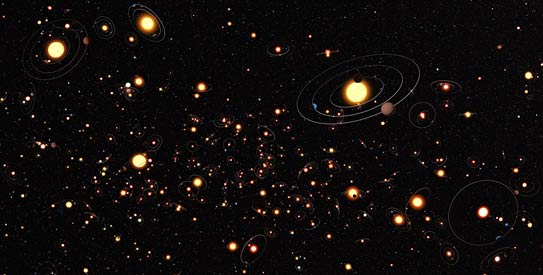
PARIS: The Milky Way is home to far more planets than previously thought, boosting the odds that at least one of them may harbour life, according to a study released Wednesday.
Not long ago, astronomers counted the number of “exoplanets” detected outside our own solar system in the tens, then in the hundreds. Today the tally stands at just over 700. But the new study, published in Nature, provides evidence that there are more planets than stars in our own stellar neighbourhood.
“We used to think that Earth might be unique in our galaxy,” said Daniel Kubas, a professor at the Institute of Astrophysics in Paris, and co-leader of the study.
“Now it seems that there are literally billions of planets with masses similar to Earth orbiting stars in the Milky Way.”Two methods have dominated the hunt over the past two decades for exoplanets too distant and feint to perceive directly.
One measures the effect of a planet's gravitational pull on its host star, while the other detects a slight dimming of the star as the orbiting planet passes in front of it.
Both of these techniques are better at finding planets that are massive in size, close to their stars, or both, leaving large “blind spots”.
An international team of astronomers led by Kubas and colleague Arnaud Cassan used a different method called gravitational microlensing, which looks at how the combined gravitational fields of a host star and the planet itself act like a lens, magnifying the light of another star in the background.
If the star that acts as a lens has a planet, the orbiting sphere will appear to slightly brighten the background star.
One advantage of microlensing compared to other methods is that it can detect smaller planets closer in size to our own, and further from their hot-burning stars.
The survey picked up on planets between 75 million and 1.5 billion kilometres from their stars -- a range equivalent in the Solar System to Venus at one end and Saturn at the other -- and with masses at least five times greater than Earth.
Over six years, the team surveyed millions of stars with a round-the-world network of telescopes located in the southern hemisphere, from Australia to South Africa to Chile. Besides finding three new exoplanets themselves -- no minor feat -- they calculated that there are, on average, 1.6 planets in the Milky Way for every star, Cassan told AFP. Whether this may be true in other galaxies is unknown.
“Remarkably, these data show that planets are more common than stars in our galaxy -- they are the rule rather than the exception,” Cassan said. “We also found lighter planets ... would be more common than heavier ones.”One in six of the stars studied was calculated to host a planet similar in mass to Jupiter, half had planets closer in mass to Neptune, and nearly two-thirds had so-called super-Earths up to 10 times the mass of the rock we call home.
Another study published the same day in Nature, meanwhile, showed that planets simultaneously orbiting two stars -- known as circumbinary planet systems -- are also far more common that once supposed.
There are probably millions of planets with two suns, concluded the study, led by William Welsh of San Diego State University in California.


























