0
0

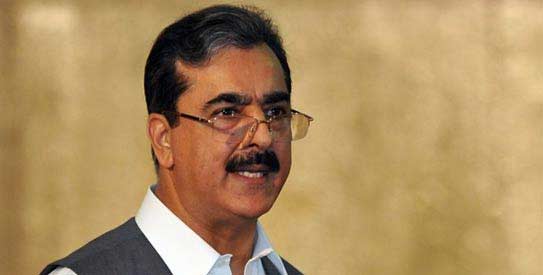
ISLAMABAD: A sense of foreboding gripped the country on Thursday as a showdown between the civilian arm of the government and the army-led security establishment looked imminent, with the Supreme Court also making it abundantly clear that instead of backing off from the so-called 'memogate' scandal, it would like to take it to its logical conclusion.
Although the federal capital had been on edge since the eruption of the memo controversy, some candid and caustic remarks by the prime minister hinting at a conspiracy to remove the government, and criticism of the Army and the Inter-Services Intelligence (ISI) led to rumours that the conflict may result in direct military intervention.
Although most Islamabad-watchers and seasoned analysts immediately brushed aside reports of an immediate coup, some were of the view that an endgame of sorts might have begun.
This was evident from Army Chief Gen Ashfaq Kayani's sworn statement before the Supreme Court insisting on the existence of a 'memo' sent to a top American military official that undermined Pakistan's national security, the defence ministry's shocking statement submitted before the apex court declaring that the government does not have operational control of the army and ISI, and Prime Minister Yousuf Raza Gilani's defiant remarks that he and his party were willing to sit in the opposition but will not accept a “state within the state” — a clear reference to the army and ISI's interference in the government's affairs.
The two frontal attacks by the prime minister within an hour of each other — first at a function to mark the birth anniversary of the Quaid-i-Azam and then on the floor of the National Assembly — suddenly took the political temperature to a new high.
The day first saw the prime minister losing his patience and expressing his fear that a conspiracy was being hatched against his government.
Simultaneously, a flurry of activities was seen at the Supreme Court where the former ambassador Husain Haqqani made his first public appearance to meet his counsel, Asma Jehangir.
Before that, to the surprise of some judges hearing the memo petitions, Attorney General Maulvi Anwarul Haq informed the apex court that he was not representing the army chief and the ISI DG, whose replies were at odds with those of the civilian leadership.
Although the prime minister had several times in the past stated that conspiracy was being hatched against his government and the present parliament, it was for the first time that he raised his finger towards the powerful military establishment when he said that “a state within the state” would not be tolerated and that “all institutions, including the ministry of defence, should be answerable to parliament and to the chief executive, who is the prime minister”.
And perhaps only to allay any doubts, he later went on to say on the floor of the National Assembly that he had set up a commission to know about those responsible for allowing Al Qaeda leader Osama bin Laden to live in Abbottabad for six years.
The speeches from the prime minister came six days after he chaired a meeting of the Pakistan Peoples' Party (PPP) parliamentary group in which some members openly suggested that he should seek resignation of the ISI chief.
Some of the members even criticised the government for not having done so soon after the May 2 operation in Abbottabad.
The reaction in political circles over the conflict between the army and the government coming out in the open was a mixed one.
A number of government's allies, and some nationalists groups, called for fresh efforts to close ranks and prevent military intervention so that no harm came to democracy.
But leaders of the Pakistan Muslim League-Nawaz (PML-N) and Imran Khan's Tehrik-i-Insaf were not perturbed.
In fact, some blamed the government for the standoff, making it quite clear that even if they were opposed to military intervention, some of these groups may prefer an action that may result in the removal of the present government.
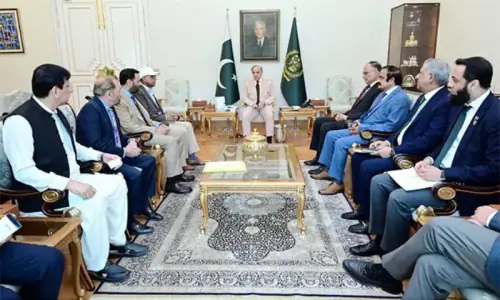
However, a meeting between the President and the prime minister after Mr Gilani's speeches and shuttle diplomacy by intermediaries, including envoys of two Western countries, suggested that serious efforts were on to restore a semblance of sanity.
By late in the evening, some of them were confident that they would be able to heal the rift, at least for now.