0
0

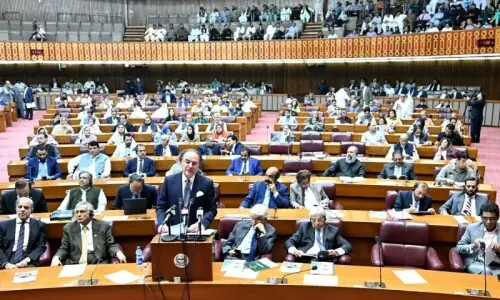
ISLAMABAD: Despite some fireworks in the National Assembly and a standoff on the streets of Islamabad and nearby Rawalpindi over gas shortages, both the government and parliamentary opposition vowed on Monday to protect the democratic system against any conspiracy from the outside. And an apparently confident Prime Minister Yousuf Raza Gilani, who welcomed what he saw as renewed commitments to democracy by PML-N president Nawaz Sharif and opposition leader Chaudhry Nisar Ali Khan, assured the house that there was no possibility of any martial law or any government of technocrats being imposed on the country.
Before the prime minister, Chaudhry Nisar tinged his second tirade against the government in Monday’s lower house sitting — mainly over difficulties faced by domestic consumers in the two cities for the past few days due to gas shortages — with an assurance that drew cheers from lawmakers from both sides of the political divide: “We can give you in writing — and we can give it in writing to people of Pakistan – that if any undemocratic force endangers the system, we will be together.”
The prime minister, who came to the house later, said he appreciated the opposition leader’s remarks in the house about the democratic system that he said had heard in his official residence as well as a pro-democracy statement made by Mr Sharif in Karachi earlier in the day.
He expressed his confidence about the success of parliamentary democracy in Pakistan for which, he said, many political workers and leaders made sacrifices, even with their blood, and “which it is our duty to protect”.
“I assure this house that there will be no martial law, … and there will be government of technocrats,” the prime minister said, apparently referring to unrestrained conjectures in the media for weeks over the recent heart ailment of President Asif Ali Zardari and a controversial memorandum critical of Pakistan’s military leadership that an American businessman of Pakistani origin sent to a former US military chief but blamed its authorship on then Pakistan ambassador to the United States Hussain Haqqani, who denies the charge.
The memo controversy, which is being investigated by a parliamentary committee on national security and also a petition from PML-N leadership being heard by the Supreme Court, figured quite prominently in the day’s proceedings in the house but there was only a passing reference by the opposition leader to the illness of the president, who returned to Karachi overnight after two weeks of medical treatment in Dubai.
The PML-N was up in arms at the start of the day’s proceedings as it appeared trying to reflect protests it inspired in Rawalpindi and parts of Islamabad’s against gas shortages, which the government blamed on a stay order given by the Islamabad High Court to protect compressed natural gas (CNG) stations from usual gas loadshedding and said Rawalpindi too was hit by low gas pressure because of a combined supply system, particularly in neighbourhoods housing most of more than 500 CNG stations in the two cities.
And the opposition leader, while seeking firm assurances for the implementation of a cabinet decision to spare domestic consumers of gas loadshedding, also took the government to task for alleged inefficiencies, disregard of parliament by ministers and accused the prime minister of being derogatory to the Supreme Court by describing the memo controversy as a non-issue while the matter was still before the court.
He came with a second onslaught against the government after PPP information secretary Qamar Zaman Kaira objected to what he saw as undignified attacks on his party’s leadership before PPP chief whip and Religious Affairs Minister Khurshid Ahmed Shah came with a conciliatory prescription on behalf of the government asking both sides to “remain within limits of (mutual) respect” in even being most bitter against each other and warned the house of what he saw as efforts to involve the country in issues similar to those raised in the past with the help of judges to “overturn the dice-board of democracy”.
“I am seeing the same situation now (of efforts being made) to pitch institutions and politicians against one another … as if we are enemies,” the minister said after recalling confrontations of both the PPP and PML-N governments in the 1990s with a Supreme Court then headed by Justice Sajjad Ali Shah.
The minister assured the house that the government would seek a withdrawal of the Islamabad High Court stay order to CNG stations on the next hearing of the case on Wednesday and said if it were done the present gas problem for domestic consumers of the two cities would be removed.
It was after a counsel for restraint from the minister and a plea from ANP chief Asfandyar Wali Khan to “let bygones be bygones” that Mr Kaira announced forgoing his right to respond to Chaudhry Nisar’s second onslaught that alleged PPP compromises against two previous military governments while responding to Mr Kaira’s references, in a previous speech last week, to a pardon granted to Mr Nawaz Sharif from jail sentences in 2000 by then president Pervez Musharraf for accepting a 10-year exile in Saudi Arabia.
Chaudhry Nisar compared the pardon for the PML-N leader on the intervention of Saudi Arabia to appeals made by several foreign leaders for sparing the life of former prime minister Zulfikar Ali Bhutto after his controversial conspiracy-to-murder conviction but which were rejected by then military ruler General Ziaul Haq.
But he escaped an expected rebuttal on this count thanks to an apparent mood on the treasury benches to appease rather than provoke the opposition.
The prime minister, during his brief speech in the house, also assured senior PML-N leader Javed Hashmi of inquiring into how his name was shown in a reply to a question in the house as a recipient of 30,000 pounds sterling as government aid for his medical treatment and said he would offer his regrets if it was proved wrong.