0
0

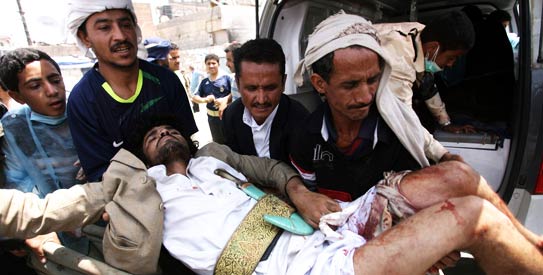
SANAA: Yemeni security forces killed 20 people on Monday, including three dissident soldiers and two children, raising the death toll over 24 hours to 46, medics said as protesters thronged Sanaa's streets.
The wave of bloodletting coincided with the arrival in Sanaa of UN envoy to Yemen Jamal Benomar and Gulf Cooperation Council chief Abdullatif al-Zayani for what a diplomat said was the signing of a UN roadmap for the transfer of power from embattled President Ali Abdullah Saleh to his deputy.
“Twenty people, including two children and three soldiers from the First Armoured Brigade” were killed in Sanaa, a medic said, referring to a unit headed by dissident General Ali Mohsen al-Ahmar.
Reinforcements were sent to Sanaa amid reports of clashes between armed civilians and security forces on one side and Ahmar's troops on the other.
The medics could not say where most of the bodies were arriving from, but witnesses said security forces opened fire on protesters camping out at Al-Zubair Road near Change Square, the epicentre of anti-regime protests.
The protesters retaliated by throwing stones at the security forces, sparking fresh gunfire, the witnesses said.
The children, identified as Anas and Louay al-Suaidi, were shot dead by snipers in their parents' car on a road west of Change Square, their mother said.
On Sunday, a march by tens of thousands of protesters from Change Square to the city centre ended in chaos when they came under heavy fire from security forces at Al-Zubair Road, which is near the office of Saleh's son Ahmed, head of the elite Republican Guard.
Witnesses said the protesters were sprayed by water cannons and tear gas, and also baton charged before the security forces opened fire with machine guns.
Medics reported 26 people killed and 500 wounded in Sunday's clashes.
Early on Monday, thousands of protesters staged another march from Change Square to join the tens of thousands who had camped at Al-Zubair Road.
Two protesters were also killed in the flashpoint city of Taez, south of Sanaa, witnesses said.
State news agency Saba reported the UN envoy Benomar arrived in Sanaa on Monday, while an airport official told AFP that GCC chief Zayani had also flown in.
A Western diplomat in Sanaa told AFP that the signing of the UN roadmap was scheduled for later on Monday.
A high-level Saudi official said on Saturday that Vice President Abdrabuh Mansur Hadi would sign a Gulf-brokered initiative “within a week” after the United States said on Thursday that this is what it had “hoped” would happen.
Saleh, who has ruled Yemen since 1978, has been recovering in Saudi Arabia after a June 3 explosion at his presidential compound, but has so far refused to transfer power to his deputy or to sign the Gulf Initiative.
His refusal has angered the plan's Gulf sponsors who, along with many in the international community, fear a total meltdown of the political order in Yemen could pave the way for Al-Qaeda-linked militants to overrun the country.
The GCC plan, proposed last spring, calls on Saleh to step down as president and hand over all constitutional authorities to Hadi. In return, Saleh and his family would become immune from prosecution.
Yemen's government on Monday expressed its “sorrow and condemnation” over Sunday's violence.
“The government of Yemen expresses its sorrow and condemnation for all acts of violence and bloodshed as those happened yesterday in Sanaa,” Foreign Minister Abu Bakr al-Kurbi told the UN Human Rights Council in Geneva.
“It is unfortunate that these events occurred at a time while some solutions for the political crisis started to appear,” he said.
“The government will investigate and hold accountable all those who were in charge of these acts.”
Oxfam said in a statement, meanwhile, that one in every three Yemenis goes hungry every day because of the political stalemate that has pushed the economy to the verge of collapse and the government towards total paralysis.
“Widespread hunger and chronic malnutrition have taken hold in Yemen,” the international charity said in a report on the country of 22 million.