0
0

ISLAMABAD, May 21: Rising poverty in Pakistan necessitates that 10 per cent of the Gross Domestic Product (GDP) be spent on social sector including education, health, safe drinking water, sanitation and basic infrastructure to achieve Millennium Development Goals (MDGs) by 2015.
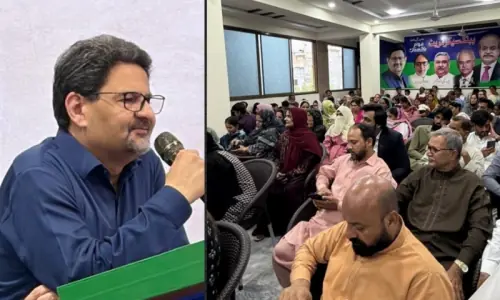
This was a key demand at a pre-budget seminar on ‘We Demand Budget for MDGs’ jointly organised by Global Call to Action against Poverty (GCAP), Awaz Foundation Pakistan and Journalists for Democracy and Human Rights (JDHR) here on Saturday.
At present, Pakistan spends only three per cent of its GDP on health and education whereas India allocates nine per cent for these sectors.
The speakers reminded that Pakistan had committed to achieving MDGs at the UN Summit held in September 2010 as well as at the Saarc Summit held in Dhaka also in 2010.
Dr Zafar Moeen Nasir, senior economist from Pakistan Institute of Development Economics (PIDE), said since Pakistan had committed to achieving MDGs by 2015, the issue of growing hunger and poverty should be addressed and mismanagement in economic governance must be eradicated.
“We need to decentralise the development budget at district level by allocating Rs2 billion a year consecutively for 10 years so that all the districts can plan and implement their development needs. Putting all districts in competition can produce good results. We need to rationalise subsidies limiting it to a few food items to end hunger i.e. the first MDG,” he added.
Mr Nasir said in the forthcoming budget, Rs710 billion would be earmarked for education, child and female mortality and other social sector developments. Of them, Rs430 billion would be spent through provinces while Rs280 billion would be spent by the centre. He called for linking economy with MDGs and said the budget estimation should be based on actual income and spending.
Joint Secretary, Ministry of Finance, Sajjad Ahmad Shaikh said the budget was announced for the welfare of the general public. Budgetary deficit was decided in advance, which was bridged through loans, he said.
“Before budget allocation, we do situational analysis of each sector. We need to do post-budget analysis to ensure implementation on the budget. We need to understand limitations of the government. We should take up all MDGs achievement-related demands to the provinces after the 18th Amendment, as now resources will be transferred to the provinces,” he added.
He said through legislation, it had been made mandatory to maintain fiscal responsibility and debt ratio had been controlled under this legislation and hence in a way commitments relating to MDGs were given protection. There should be a pressure on the government to press for their demands on MDGs. He said that the focus should be on direct taxation and a campaign should be launched to safeguard the poor who are affected by indirect taxes.
Fayyaz Baqir, Director Akhtar Hamid Khan Centre, regretted that the financial system of Pakistan transferred resources from the poor to the rich, which should be reversed. “We need to analyse the financial system to tell the poor the truth and plug in all the loopholes,” he suggested.
Earlier, setting the scene for the debate, JDHR President Shafqat Munir said the MDGs were not luxurious concessions but very basic services to be dispensed with at local level. The government needed to generate resources and spend them on people through local representatives.
To effectively provide these services, there was an immediate need for restoration of local governments with strong governance mechanism and financial independence and accountability and monitoring of the system by the citizens, he said.
On resource mobilisation for MDGs, Mr Munir demanded imposition of tax on agriculture income. “It is ironic that the rich are paying peanuts in tax while the poor paying billions in terms of indirect taxes,” he added.