0
0

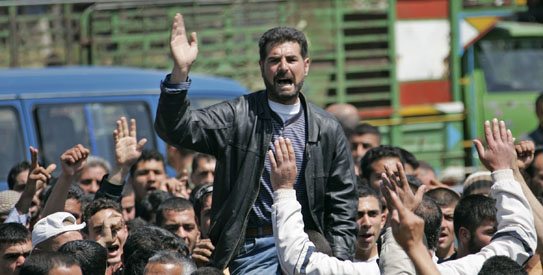
BEIRUT: Syrian protesters called Tuesday for a one-day nationwide general strike, urging students to skip school and workers to bring commerce to a halt in a new strategy of defiance against government crackdowns that appear to be turning more brutal and bloody.
The strike, planned for Wednesday, marks a shift by opposition forces to strike at President Bashar Assad's regime from new angles: its economic underpinnings and ability to keep the country running during two months of widening battles.
A sweeping popular acceptance of the strike call would be an embarrassing blow to Assad and show support for the uprising in places, such as central Damascus, where significant protests have yet to take hold and security forces have choked off the few that have taken place.
"It will be a day of punishment for the regime from the free revolutionaries ... Massive protests, no schools, no universities, no stores or restaurants and even no taxis. Nothing," said a statement posted on the main Facebook page of the Syrian Revolution 2011.
The strike call came as the United States and European Union planned new sanctions against the Syrian leadership. In Washington, US Secretary of State Hillary Rodham Clinton and EU foreign policy chief Catherine Ashton told reporters that the tighter measures could be imposed in the coming days.
Meanwhile, watchdog groups and Syrians fleeing into neighboring Lebanon added to the accounts of violence.
A Syrian rights activist, Mustafa Osso, said government agents chased and beat students taking part in a protest against Assad's regime at a university in Aleppo, Syria's second-largest largest city. Security officials in Lebanon said at least 170 people entered the country Tuesday, including a 2-year-old girl with a shrapnel wound in her chest.
Syrians pouring over the Lebanon border in recent days have described horrific scenes of execution-style slayings and bodies in the streets in the western town of Talkalakh, which has been reportedly encircled by security forces. Osso, head of the Kurdish Organisation for the Defense of Human Rights and Public Freedoms in Syria, said there were reports of gunfire in Talkalakh on Tuesday, but it was not clear whether there were injuries.
At least 16 people — eight of them members of the same family — have been killed in recent days in Talkalakh, a town of about 70,000 residents, witnesses and activists said.
Syria's official news agency said eight soldiers and policemen were killed Tuesday and five others were wounded while pursuing fugitives in Talkalakh and nearby areas. The report said security forces arrested several fugitives and confiscated a large amount of weapons.
Syria's top rights organisation has said that the crackdown by Assad has killed more than 850 people since protests erupted in mid-March in the most serious threat to his family's 40-year dynasty. Thousands of others have been detained.
A pro-democracy activist in the central city of Homs expressed support for the nationwide strike, calling it "the only way to hurt the regime without putting people's lives at risk."
But the activist, speaking by phone to The Associated Press, doubted the response would be big.
"The majority of businessmen and merchants are either supportive of the regime or fear for the businesses. They have too much to lose," he said, speaking on condition of anonymity for fear of reprisals.
Anthony Skinner, an analyst at Maplecroft, a British-based risk analysis company, said he expected the current conflict to become even more protracted and bloody.
"Although the crackdown has failed to snuff out dissent, protests have also not gained sufficient momentum to overextend the armed forces," he said.
On Tuesday, the National Organisation for Human Rights said in a statement that at least 41 people were killed in the past five days in the villages of Inkhil and Jassem near the southern city of Daraa, where the rebellion took root.
Ammar Qurabi, the head of the human rights organisation, also said a "mass grave" with 24 bodies, and another containing seven bodies including a father and his four sons, were discovered in Daraa on Monday. Calls to Daraa on Tuesday seeking to verify the reports were unsuccessful.
International rights watchdog Amnesty International urged Syrian authorities to carry out a prompt, impartial investigation into reports of the graves.
"If true, these reports of multiple corpses buried in a makeshift grave show an appalling disregard for humanity," said Malcolm Smart, Amnesty International's Middle East and North Africa director.
A Syrian Interior Ministry official dismissed the reports about a mass grave in Daraa as "completely baseless." The unnamed official, quoted by state-run news agency SANA, said Tuesday that the "allegations came in the context of the campaign of provocation, slander and fabrication" against Syria.
The official said an "armed terrorist group" opened fire on a police vehicle near Homs, killing two policemen and wounding four others, including an army officer.
Assad has blamed the unrest on armed thugs and foreign agitators. He also has played on fears of sectarian strife to persuade people not to demonstrate, saying chaos would result.