0
0

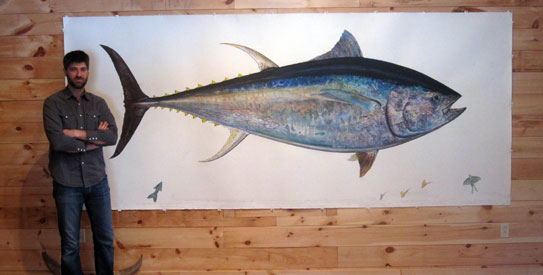
NEW HAVEN, Connecticut: The nearly three century old method for naming newly discovered nature will face a rebellion this Friday at Yale University.
The topic is not just some dusty debate in the halls of academia.
Adventurous scientists who capture previously unknown fish, birds and other creatures and others who work with fossils and microorganisms say they have an increasing problem in assigning accurate names to their subjects.
James Prosek, a naturalist, author and artist, realized while working on a book called “Trout: An Illustrated History” that traditional nomenclature for living things is increasingly unaligned with scientific knowledge.
Genetic research was upending common understandings about the trout he caught with his handmade flies.
For example, he had caught brook trout native to the Connecticut streams where he fished as a child, rainbow trout common in the US west and brown trout of European origin.
All three were called “trout” even though the brook trout was genetically more akin to Arctic char, rainbow trout more akin to Pacific salmon and brown trout to Atlantic salmon.
“Technically, it was no longer correct even to call the book I was working on ‘Trout,’” Prosek said.
On Friday, Prosek will join evolutionary biologists and other thinkers from Yale and the Smithsonian Institution in Washington DC at Yale’s Whitney Humanities Center for a symposium titled “Naming Nature: A conversation on the nature, uses and limitations of biological taxonomies.”The controversial idea at the forum is that it could be time to overturn the widely used naming system developed by Swedish botanist Carl Linnaeus 275 years ago.
The Linnaean system divides the natural world into neat ranks and gives species joint Latin names, such as Homo sapiens for humans, with groupings based on physical similarity.
The reformists at the Yale conference, including Yale geology professor Jacques Gauthier, evolutionary biologist Michael Donoghue, and Smithsonian zoologist Kevin de Queiroz, say the Linnaean system has had its day.
“The Linnaean system is simply not up to the task of handling the sheer amount of information we’re amassing about diversity,” Donoghue said.
Their idea is to replace the Linnaean system with something called “PhyloCode.” Under this system, life forms are ranked by shared ancestors and Darwinian principles – in other words by their branch on the molecular family tree.
Donoghue and his colleagues have already converted the Yale Herbarium’s plant collection from the Linnaean system to PhyloCode.
Converting from one system to the other generally does not require a name change, Donoghue said, except to correct a name to reflect new knowledge of evolutionary relationships.
“The goal is to apply the same names in ways that make more sense,” added De Queiroz, who gave the example of the termite as presenting a different outcome under the PhyloCode than the traditional approach.
In a published essay, De Queiroz noted that termites have recently been determined to descend from roaches.
Under the pre-evolution Linnaean system, he wrote, “because roaches and termites were considered mutually exclusive and ranked as orders, it’s been proposed that termites be demoted in rank to a family of roaches” to take into account the new knowledge.
However, to make that simple change, he wrote, the Linnaean system dictates that “the name of the group of termites be changed (from Isoptera to Termitidae) and the name Termitidae change its reference from a subgroup of termites to the group of all termites – even though the hypothesized composition of both of these groups has remained unchanged.”
And that’s just the tip of the iceberg, because now all the former termite families have to be demoted in rank to subfamilies, and all of the former termite sub-families have to be demoted in rank to tribes, etc, and all of these changes in rank necessitate changes in the names of the taxa that they designate.
“With examples such as this in mind, it’s hard to believe that the rank-based code used in zoology has a stated objective of promoting stability in the scientific name of animals!” De Queiroz wrote.
Applying the PhyloCode, only a single name change would be required to reflect the new knowledge of termite evolution.
But not everyone is in favor of adopting the PhyloCode.
One panelist, Richard Prum – a Yale evolutionary biologist who reconstructed the red, white and black feathers of a flightless dinosaur by analyzing its fossilized feather structure – objects.
“The PhyloCode doesn’t solve a useful problem,” said Prum, winner of a MacArthur Fellowship genius grant and teacher of an evolution of beauty seminar with Yale philosopher and art critic Jonathan Gilmore.
“I suggest a name registry, building up a registry of meanings with names,” he said.
As a naturalist on the frontlines who conceived of and organized the panel, Prosek had a practical-minded perspective.