



 0
0

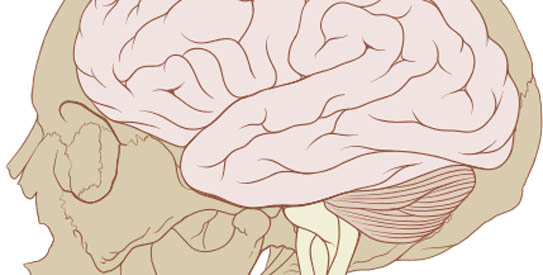
WASHINGTON: Human brains have shrunk over the past 30,000 years, puzzling scientists who argue it is not a sign we are growing dumber but that evolution is making the key motor leaner and more efficient.
The average size of modern humans — the Homo sapiens — has decreased about 10 percent during that period -- from 1,500 to 1,359 cubic centimeters, the size of a tennis ball.
Women’s brains, which are smaller on average than those of men, have experienced an equivalent drop in size.
These measurements were taken using skulls found in Europe, the Middle East and Asia.
“I’d called that a major downsizing in an evolutionary eye blink,” John Hawks of the University of Michigan told Discover magazine.
But other anthropologists note that brain shrinkage is not very surprising since the stronger and larger we are, the more gray matter we need to control this larger mass.
The Neanderthal, a cousin of the modern human who disappeared about 30 millennia ago for still unknown reasons, was far more massive and had a larger brain.
The Cro-Magnons who left cave paintings of large animals in the monumental Lascaux cave over 17,000 years ago were the Homo sapiens with the biggest brain. They were also stronger than their modern descendants.
Psychology professor David Geary of the University of Missouri said these traits were necessary to survive in a hostile environment.
He has studied the evolution of skull sizes 1.9 million to 10,000 years old as our ancestors and cousins lived in an increasingly complex social environment.
Geary and his colleagues used population density as a measure of social complexity, with the hypothesis that the more humans are living closer together, the greater the exchanges between group, the division of labor and the rich and varied interactions between people.
They found that brain size decreased as population density increased.
“As complex societies emerged, the brain became smaller because people did not have to be as smart to stay alive,” Geary told AFP.
But the downsizing does not mean modern humans are dumber than their ancestors — rather, they simply developed different, more sophisticated forms of intelligence, said Brian Hare, an assistant professor of anthropology at Duke University. He noted that the same phenomenon can be observed in domestic animals compared to their wild counterparts.
So while huskies may have smaller brains than wolves, they are smarter and more sophisticated because they can understand human communicative gestures, behaving similarly to human children.
“Even though the chimps have a larger brain (than the bonobo, the closest extant relative to humans), and even though a wolf has a much larger brain than dogs, dogs are far more sophisticated, intelligent and flexible, so intelligence is not very well linked to brain size,” Hare explained.
He said humans have characteristics from both the bonobo and chimpanzee, which is more aggressive and domineering.
“The chimpanzees are violent because they want power, they try to have control and power over others while bonobos are using violence to prevent one for dominating them,” Hare continued.
“Humans are both chimps and bobos in their nature and the question is how can we release more bonobo and less chimp.
“I hope bonobos win... it will be better for everyone,” he added.

























