HYDERABAD, Nov 5: Eminent scholar and political analyst Dr Rasool Bux Raees has said that political and radical Islam poses a great challenge to modern states and political system of Pakistan.
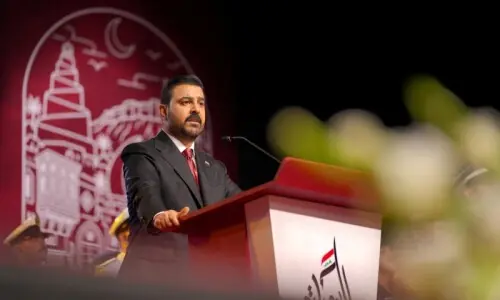
Delivering a lecture on “Modernism and the challenge of radical Islam” organised under Dr Feroze Ahmed memorial lectures series by the Centre for Peace and Civil Society, Dr Raees said: “Without simultaneous practice of Islam and modern sciences, we as a nation cannot win political power and maintain our rightful place among the comity of nations.”
He said that an individual or a nation must not keep looking back if they wanted to move forward. A nation must focus its energies on learning modern trends of development, science and technology, he said.
“By making ourselves modern as a nation we can sustain our Islamic identity as well. It will be hard for us to catch up with the modern world shoulder to shoulder. This is what I call real modernism,” the scholar said.
Dr Raees believed that a people must follow modernism not only in its spirit but also in values, politics, economy, trade and business and rationality as well. “We can become both modern and Muslim simultaneously,” he said.
He laid emphasis on adopting political modernism, which he believed, envisaged rule of law, constitutionalism and a government based on democratic principles.
Quaid-i-Azam Mohammad Ali Jinnah said in his first address to the first constituent assembly of Pakistan that “foundation of Pakistan is not that we are Muslims but it's based on citizenship,” he said.
Elaborating the Quaid's quote, he said that an authoritarian ruler could never be modern, because he would abrogate the Constitution, violate rule of law and human rights, deprive parliament of sovereignty and discard basic principles of federalism.
Dr Raees said in answer to a question that feudal lords, dictators and ruling elites were of two types: one traditional elite the second status elite, and they had long been enfeebling the spirit of modern state in the country.
As a result, Pakistani politics had virtually lost its legitimacy and exploited political parties, parliament and procedural democracy only in favour of their vested interests, he said.
He criticised military regimes and authoritarianism in the country and tried to make participants understand concept of modernism and radical Islam.
A large number of scholars and leaders of civil society and public opinion attended the lecture.