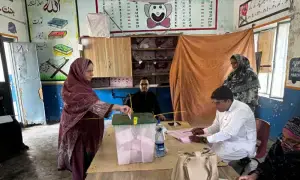
KABUL A record number of women are running in Afghanistan's critical parliamentary elections next month despite many being inundated with threatening phone calls, including death threats from insurgents.
Amid ever-rising violence, which some people fear could foster a repeat of last year's catastrophic presidential election, women are struggling to campaign at all outside a few areas, poll monitors say.
Even in Kabul, the capital, where the Guardian has interviewed a number of female candidates, women say they are facing daily obstruction from conservative hardliners.
With voting billed for September 18, Kabul's streets have been plastered in posters and billboards, many of which show the faces of would-be female MPs in the capital, the number of which has more than doubled since 2005. However, many of the posters do not stay up long, or get defaced with slashes of bright red ink.
“I've told my team that we just have to expect this sort of thing,” says Fareda Tarana who has just been told that another batch of her expensive posters had been torn down on Kabul's busy airport road.
Tarana does not just owe her prominence to her trademark long eye lashes pictured on billboards but also to Afghan Star - the country's Pop Idol - where she came eighth in 2005. “I cannot run in Herat, because the people say they will not stand a singer woman like me,” she says.
Relatively speaking, Kabul is far more secure and liberal minded, but Tarana still gets 10 calls every day from anonymous men angry at a woman standing for MP.
For Najila Angira the calls are more serious. During one recent call, a Taliban commander from Wardak, a province just a short drive south of Kabul, denounced her and said he would kill her.
“He had read my biography, which said I lived outside of Afghanistan during the Taliban time. He said, 'why are you saying bad things about the Taliban?'”
For the Taliban, Angira stands for almost everything a woman should not be. Not only is she standing for election, the 30-year-old is also a businesswoman, running a successful logistics firm out of her family flat in Kabul. To make matters worse, her election literature attacks the Taliban, branding their rule “dark days”.
“The Taliban time is finished,” she says. “We are making the new Afghanistan and they will never come back.”
Other female candidates have had to deal with the more general male prejudice, including Hamida Ameri, a teacher whose attempt to campaign in a mosque prompted male worshippers to walk out. “The mullah was a good man and had invited me to talk in his mosque,” she says. “But when I did, the men started shouting that I had destroyed the holy environment of the mosque. Some people stayed ... but most of them left.”
The situation is worse in more dangerous provinces outside Kabul. According to the Free and Fair Election Foundation of Afghanistan (Fefa), women candidates were “inundated” with late-night threatening calls both from insurgents, political rivals and even some ordinary people.
“Women's campaigns were barely visible in the most insecure provinces in the south and south-east of the country, and female candidates complained of government indifference to their security concerns,” Fefa said in a recent report.
Despite the dangers the number of women seeking representation in parliament has risen sharply, from 328 in 2005 to 406 across Afghanistan, according to an international election monitor in Kabul. They are running for at least 64 of the 249 seats reserved for women.
The issue of women's seats in parliament has long been a bugbear of conservatives, repeatedly cited as an example of foreigners imposing a practice alien to Afghan culture.
One candidate in Kabul refuses to put her photograph on posters. “In all these pictures [women] look like they are advertising a fashion show or a movie or something,” said Farkhunda Zahra Naderi.
Her own posters are dominated by a pear - the symbol she chose from a random selection of three pictures each candidate puts on the ballot paper to help the largely illiterate electorate vote.
Everyone is all too aware that the stakes are far higher than a fashion contest, not least businesswoman Angira. “If I win I will serve the people in parliament,” she says. “But if I lose I might have to leave because I will be in danger. No one is going to give me security to protect myself from the Taliban.”—Dawn/The Guardian News Service