Tunisia provided the first spark of the Arab spring and became the poster child for its positive achievements: the overthrow of a dictator with relatively little bloodshed, an orderly transition, free elections and the rise of a long-banned Islamist party that strove for inclusiveness and projected an image of moderation. Compared with instability in Egypt, carnage in Syria and sporadic violence in Libya, it had been performing fairly well.
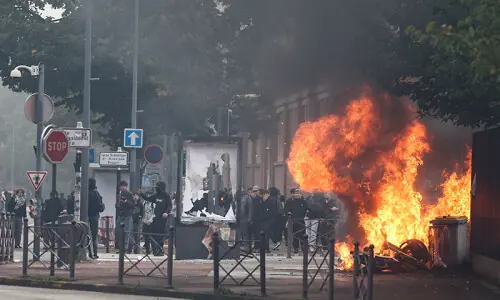
But the assassination of a leading leftwing politician, Chokri Belaid, a fierce critic of the Ennahda-led government, has turned the spotlight on Tunisia’s serious problems in the most sensational way.
In October 2011 Ennahda won a free election which produced an assembly in which it has a majority with two secular allies. Rashid Ghannouchi, the party’s veteran leader who was exiled in Britain before the revolution, has had a good press — though better abroad than at home, where the jasmine revolution has not been smelling too sweet recently.
Belaid represented opposition groups who were unhappy with Ennahda, calling days before his death for a national dialogue to resolve the escalating crisis.
Ennahda condemned his killing but suspicion fell at once on Salafi groups who are unhappy with the social liberalism of what has been the most secular of Arab countries since the days of Habib Bourguiba, its first president after independence from France, in the 1950s.
The statement issued by the British Foreign Office probably got it about right: “This was a cowardly and barbaric act aimed at destabilising Tunisia’s democratic transition,” it said.
The government has been blamed for failing to act against intimidation and violence by mosque preachers and on extremist social networking sites. Assaults against journalists, political activists and artists have not even been investigated, let alone prosecuted.
Salafis attacked the US embassy in Tunis last September after the deadly assault on the US consulate in Benghazi and embassy in Cairo. Last October a leaked video featuring Ghannouchi talking to Salafi leaders was exploited by Ennahda’s opponents to suggest that the two movements agreed on the “re-Islamisation” of institutions such as the army, the police and the media. Attempts to discredit the video and to defuse the crisis did not dispel growing mistrust.
Ennahda’s problems with radical Islamists are reminiscent of those experienced by Mohamed Morsi and the Muslim Brotherhood government in Egypt.
But unlike in Egypt, Tunisia’s ruling party has not forged a strong relationship with the country’s army and security establishment, which is said to be ill-equipped to deal with violent extremists.
Hundreds, perhaps thousands, of Tunisians have reportedly left in recent months to join jihadi groups in Syria, Yemen and Mali.
Beyond the Islamist-liberal divide lie broader issues as the government’s struggles to cope with mounting economic and social pressures over the problems it inherited when Zine al-Abidine Ben Ali fled to a gilded exile in Saudi Arabia.
In November last year thousands of frustrated young men took to the streets in a desert town called Siliana, where clashes with security forces ended only after the government promised to replace the state governor and provide more jobs and aid.
Not much, it seemed, had changed since Mohamed Bouazizi burned himself to death two years earlier and set in train the uprisings that are still transforming the Middle East and north Africa.
Recent talks had failed to reach agreement over redistributing power after one of Ennahda’s two coalition partners threatened to withdraw from the government unless Islamist officials connected to Ennahda were replaced.
It has become fashionable to decry the transformation of the Arab spring into an “Islamist winter” beset by violence and extremism.
That remains an exaggerated and partial view. The first political murder in post-revolutionary Tunisia does not erase the country’s other achievements. But its reputation as a model for transition from dictatorship to democracy is now looking distinctly tarnished.
By arrangement with the Guardian