KARACHI, May 25: Aamir Khan, the chief of his own faction of the Mohajir Qaumi Movement (MQM-H), announced that he was rejoining the Muttahida Qaumi Movement (MQM) on Wednesday after MQM chief Altaf Hussain accepted his public apology to end the almost two-decade-old internecine warfare and bloodshed.
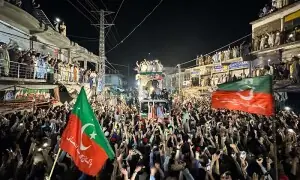
One of the major developments in the city's political history was witnessed by a large number of people at the Lal Qila Ground in Azizabad, which houses the MQM headquarters Nine-Zero, where families of the MQM's slain workers endorsed the party chief's decision.
“Mr Altaf Hussain announced that he'd pardoned Amir Khan after the family members of the martyrs and missing workers forgave Aamir Khan,” said a brief MQM statement, adding that Mr Hussain also ratified Mr Khan's reinstatement as an MQM worker.
“Altaf Hussain and family members of the martyrs and missing workers of the MQM have pardoned the former leader of the MQM Aamir Khan at his request to forgive him.”
Workers of the once Aamir Khan-led MQM-H said they would follow their leader's line and that the “entire set-up” would now be part of the MQM.
“It's the decision of our leader and we respect that,” said Feroze Haider, a close aide of Aamir Khan.
“From now on we are part of the MQM and no parallel party exists at our end. No separate activity is scheduled after today's announcement.”
The MQM leadership vowed to pursue the “policy of reconciliation” and said that it was Aamir Khan who had come up with a “request” that was accepted in the interest of peace in the city.
“When we returned to the no-go areas a few years ago, Altaf Hussain had announced a general pardon for all those who were not involved in the killing of our workers and other crimes,” said Syed Faisal Ali Sabzwari, a Sindh minister and the MQM's deputy parliamentary leader in the provincial assembly.
When asked if the same offer was available to the Afaq Ahmed-led faction of the MQM-H, he said some organisational matters were taken up before any decision, but stressed the “party policy of peace and reconciliation”.
For analysts, who witnessed the city's volatile law and order very closely from 1992 to 2011, the merger of the MQM-H with its parent party, the MQM, proved how unsuccessful was the “experiment” of the military establishment that only pushed the city into bloodshed.
“This was in fact the army's plan to cut the MQM down to size,” said Mohammed Hanif, a senior journalist who covered the city's descent into bloodshed in the aftermath of the split within the MQM.
“The army's failed political experiment caused the entire city to be plunged into violence for almost two decades.”However, at the same time, he saw Aamir Khan becoming irrelevant after rejoining the MQM as the key man behind the MQM split in 1992, Afaq Ahmed, had not yet shown any interest in any such exercise.
“If we see the political history of Aamir Khan even in the MQM-H, he keeps coming and going. I hope he now plays a positive role in the MQM, but looking back to the 1990s and now, I think it's one of those sad kinds of experiments.”