KARACHI: Even as PML-N chief Nawaz Sharif was rallying street support by publicly refusing to back down from demands for the restoration of Chief Justice Iftikhar Chaudhry in February and March 2009, the party was privately telling American diplomats that the future of the then-non-functional chief justice was up for negotiation.
“Shahbaz stated that following the restoration, the PML-N was prepared to end the issue and remove Chaudhry once and for all,” reported Lahore Consulate Principal Officer Bryan Hunt in a secret American diplomatic cable describing his meeting with the younger Sharif on March 14, 2009.
“On the issue of former Chief Justice Iftikhar Chaudhry, Shahbaz claimed that the PML-N was open to negotiation, provided that Chaudhry was symbolically restored.”
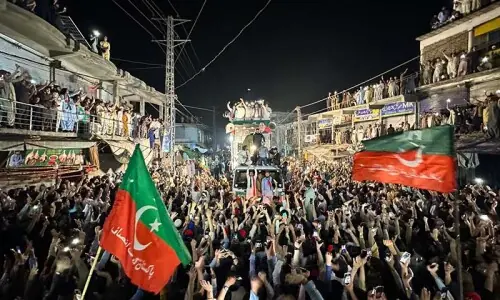
The conversation took place just a day before Nawaz Sharif would join a lawyers’ long march in a dramatic public protest for the reinstatement of judges deposed by Gen Musharraf, a demand that President Zardari had been resisting. In private, however, a different story was being told.
“Shahbaz stressed that his party could not afford the political humiliation of abandoning what had become a long-standing principle in favour of Chaudhry’s restoration,” Mr Hunt reported. “At the same time, Shahbaz claimed to understand that Chaudhry was a problematic jurist, whose powers would need to be carefully curtailed.”
Shahbaz Sharif strategised that as a judge who had taken oath under Gen Musharraf’s first provisional constitutional order, Chaudhry could be removed - once “some sort of face-saving restoration” had been carried out - “by adopting legislation proposed in the Charter of Democracy that would ban all judges who had taken an oath under a PCO from serving.”
A week earlier, in another meeting at the Lahore consulate, Shahbaz Sharif had proposed an alternative solution: creating the Constitutional Court envisioned in the Charter of Democracy and ensuring that “it be made superior to the Supreme Court. Iftikhar Chaudhry’s restoration … would then have little measurable impact, as the Constitutional Court, staffed by appointees from both parties, could nullify his decisions.”
Even before the restoration, Shahbaz Sharif confided, the PML-N leadership would agree to any constraints President Zardari might want placed on Chaudhry, “including curtailment of his powers to create judicial benches, removal of his suo motu jurisdiction, and/or establishment of a constitutional court as a check on the Supreme Court.”
“Although Nawaz publicly has said Chaudhry’s restoration is also a red line,” commented US Ambassador Anne Patterson in a separate report, “no leader in Pakistan really wants an activist and unpredictable Chief Justice. … Nawaz emerges stronger in the public eye and retains the ‘high moral ground’ by defending the judiciary.”
As late as January 22, in fact, PML-N leader Khawaja Saad Rafique had told Mr Hunt that a minimum requirement for saving the coalition with the PPP in Punjab was “full retirement of Chief Justice Hameed Dogar and appointment of Justice Sardar Raza in his place.” Chaudhry did not seem to have been a concern.
But by March 2009 he had become the PML-N’s rallying cry, and the timing clearly had to do with political developments at the time: a February 25 Supreme Court decision had declared the Sharif brothers ineligible for office, and the president had imposed governor’s rule in Punjab.
“Nawaz and Shahbaz Sharif told Principal Officer Lahore that the decision [to declare them ineligible to hold public office], which they claimed was entirely Zardari’s, was a declaration of war; they would … take their battle to the streets. Following the decision, PML-N certainly will participate in the lawyers’ march,” reported a February 2009 cable previously published in the media.
“Before the Court ruling, ‘95 per cent of the party’ had opposed joining the lawyers’ March 16 sit-in because it might lead to violence,” Opposition Leader Chaudhry Nisar Ali Khan revealed privately in a separate conversation at the US embassy.
“Now, the party had little choice but to support them.”
Cables referenced: WikiLeaks # 196903, 195758, 196939, 188203, 193807, 194540. All cables are available on Dawn.com.