0
0
KARACHI, Nov 24: Though the European Union may be expanding its borders, a 'United States of Europe' is still a fair distance away. This was among the theses proffered on the first day of a two-day international seminar held at a hotel here on Wednesday.
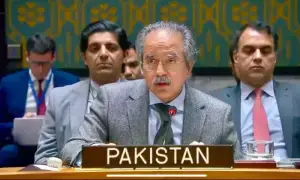
The event, titled 'East and Central Europe: the impact of EU membership on foreign policy, domestic politics and economy', has been organised by the University of Karachi's Area Study Centre for Europe in collaboration with the Hanns Seidel Foundation, Islamabad.Former foreign secretary Shamshad Ahmed, speaking on nationalism in eastern and central European states after joining the EU, asked: “Will a larger European entity be able to assimilate cultural, religious and ethnic [differences] in the new Europe?”
He said the post-world war situation was dominated by “economic regionalism”; the EU was the most advanced model of this theory. He observed that though the means would be economic, the goal for a united Europe would always be political.
Ambassador Ahmed said that we are currently “adrift in a chaotic world; economic adventurism of the 19th century is back. Injustice and oppression continue unabated. The EU is not immune to these realities”. He added that with too many members it is possible for the union to come to a grinding halt, where decision making will remain difficult.
He said 'Eastern Europe' was a “highly context-dependent, even volatile term”, adding that both world wars broke out in the region, both conflicts having their roots in nationalism. Mr Ahmed said the importance of religion in Eastern and Central Europe cannot be overstated as it plays an important role in national politics. He cited the example of the role the Catholic Church played in the anti-communist movement in Poland in the 1980s. However, he added that religion had also played a divisive role, such as in Bosnia.
Shamshad Ahmed said the 'one-size-fits-all' approach for Europe has been challenged. “For the foreseeable future the EU is not likely to become a superpower as it lacks a unified political, economic and military approach. The road towards a unified Europe is long and bumpy with speed-breakers in the way. The United States of Europe is a hypothetical scenario”.
'Keeping the peace'
Professor Fulvio Attinà of the University of Catania, Italy, spoke on the EU's Common Security and Defence Policy (CSDP). He said European defence policy had multiple objectives, which included the use of military force to “keep the peace” but also “creating conditions for stability, such as civilian tasks like keeping order in the streets, reconstructing public administration, rebuilding judicial and police infrastructure and reconciling ethnic groups” in trouble spots. He said this policy has been in vogue for the past 10-15 years.
The scholar said that intervention in other countries' affairs was caused by “domestic crises as well as international processes such as the financial crisis”. He added that due to various factors, newer entrants into the EU were less active in CSDP operations.
Dr Syed Rifaat Hussain of Quaid-i-Azam University, Islamabad, spoke of the rise of new political parties in East and Central Europe. “Political parties are central to the democratic process across the world. The democratic process in East and Central Europe has been uneven and non-linear” as states rose from the ashes of communism.
He said the transition to democracy has been difficult because these states were previously one-party totalitarian entities, with domestic policies strongly influenced by Moscow.
The scholar said the states' energy dependence on Russia was still very high, hence Moscow still enjoyed political leverage with its former satellites. Dr Hussain termed this a “vicious circle of dependence”. He said there were limits to what the EU could do for its newer members. “The EU cannot build institutions, it cannot devise solutions and it cannot build civil society”.
Poland's foreign policy was the focus of Thomas Winter's paper. The scholar, from Germany's University of Rostock, said that in the post-Cold War situation, Poland wanted to join Nato and the EU, while the former Warsaw Pact member also wanted to forge closer ties with the United States, which made it unique amongst the former communist states.
Poland was derided by some in Europe as a “Trojan donkey” for its pro-American stance; he said people asked why Poland didn't become a US state instead of joining the EU.
In Russia's shadow
Senior diplomat Shahid M. Amin spoke on the relationship between Russia and the Baltic states after Lithuania, Latvia and Estonia joined the EU in 2004. He said the Baltic states had “a very unhappy history” as they are small and have always been dominated by more powerful neighbours.
Ambassador Amin said the “historical past is the main stumbling block between the normalisation of relations between the Baltic states and Russia. Russia continues to have a hangover of imperialism and harbours ambitions of becoming a superpower again. Moscow cannot digest the fact that these small states can criticise Russia”.
He said the presence of sizable Russian minorities in the former Soviet republics posed a major issue; for example in Latvia 40 per cent of the population is non-Latvian. “The minorities continue to be restless; Russia is taking an undue interest in their welfare”.
He said the Baltic republics were the first to ditch the USSR in 1991 and considered their exit from the Soviet Union as “a return to Europe”. The senior diplomat added that EU policy towards Russia is influenced to a degree by the Baltic republics. Mr Amin said the there was an “unstable relationship” between Russia and the EU despite being declared partners.
Dr Rashid Ahmed Khan of the University of Sargodha spoke of the impact on European expansion on the Balkans. He said the dream of a unified Europe had found realisation, but it was not without difficulties.
He said the geo-strategic importance of the Balkans was that the region stood at the crossroads of Europe and Asia. “The European Union's expansion to the Balkans is the start of a process which sees Europe restoring its old links with Asia”.