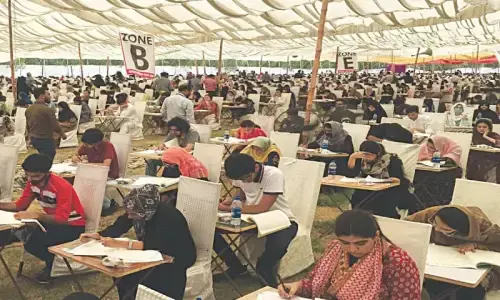
PESHAWAR: The Elementary and Secondary Education (E&SE) Department of Khyber Pakhtunkhwa has finalised the proposed bill on providing free and compulsory education at the primary and secondary level to all children of the age five to 16 years, according to officials.
They said that it was a constitutional responsibility of the provinces for which legislation was must. The Sindh, Punjab and Balochistan governments have already passed laws in this regard from their provincial assemblies. However, successive governments in Khyber Pakhtunkhwa have so far failed to fulfil this constitutional requirement, they said.
Article 25A of the Constitution states: “The state shall provide free and compulsory education to all children of the age of five to 16 years in such a manner as may be determined by law.” This article was incorporated into the Constitution through its 18th amendment.
Sindh, Punjab and Balochistan have already made such legislation
The proposed bill has already been vetted by the provincial law department and is ready to be tabled at the next cabinet meeting for approval, the officials said, addingthat afterwards it would be tabled in the provincial assembly.
They said that the proposed bill was on the agenda of the previous cabinet meeting held on Jan 24, but was dropped as Minister for Elementary and Secondary Education Mohammad Atif Khan was abroad.
Under the draft bill, the officials said, the parents would be punishable with imprisonment up to one month or fine which may extend up to Rs100 for every day after the conviction for not sending children to schools or with both.
Section 5 of the proposed bill states: “Government may, by notification, constitute a School Attendance Authority (SAA) for each school for the purpose of this act and shall consist of members, as may be determined by government.” It further states that SAA would ensure that every child shall attend a school under its jurisdiction and shall take such steps as it may consider necessary or as may be specified by the government.
Reasonable excuses for non-attendance of the school by a child are stated to be incapability of a child to attend school by reasons of sickness, infirmity, mental incapacity or where there is no school within a distance of two kilometers radius of the residence of the child.
The proposed bill allows the SAA to establish a Taleem Fund to be maintained at a scheduled bank for utilizing on welfare of the students.
Section 7 (2) of the draft bill states: “The Fund (Taleem Fund) shall consist of grants made by the federal, provincial, district governments and all voluntary contribution from the philanthropists, alumni, students and parents.”
Asked how the law would be implemented in areas where no government school is available, a senior official in the education department told Dawn that they would ascertain the accurate number of out-of-school children through the ongoing survey of the education department.
He said that the survey would be completed by the end of next month.
“The provincial government will enrol the out-of-school children in private schools in the areas where there are no government schools,” he said, adding that the provincial government would pay the tuition fee of such students through a voucher scheme.
Asked if there is no private school in an area, the official said that the next option with the education department would be to establish a community school. He said that over 1,436 community schools had already been functioning in the province.
Over two decades ago the Khyber Pakhtunkhwa Compulsory Primary Education Act, 1996 was passed by the provincial assembly, but so far it has not been implemented.
The said law also makes it binding on the government to provide free education to children at primary level.
Published in Dawn, January 30th, 2017