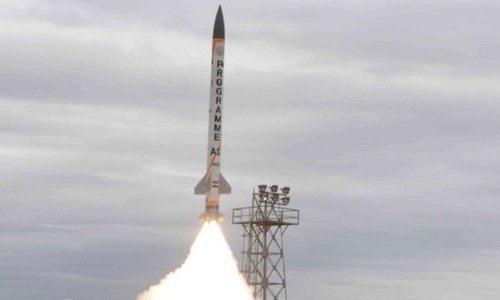
The strategic forces of Pakistan, with the testing of the 2,200 kilometre range Ababeel ballistic missile, have achieved vital technological and deterrence capability with the introduction of a missile with multiple independently targetable re-entry vehicle (MIRV) compatibility.
The Ababeel's MIRV capability means it can carry multiple warheads, instead of a single payload. Hence, it is a single missile that provides the strategic capability of hitting multiple targets with a single launch. Such missiles greatly increase the potency of a country’s strategic nuclear arsenal.
Pakistan has become the seventh country in the world to now posses the technology, which was developed in the late '60s by the Americans and Russians.
India first tested a MIRV capable missile in 2012, with the successful launch of the Agni-V. India conducted its second successful test in 2013. The tests conducted by India had offset the strategic strike balance in South Asia.
In order to maintain that balance, it had become vital for the Pakistani strategic forces to develop MIRV capable missiles.
Pakistan’s strategic deterrence challenged
India’s quest for a ballistic missile defence (BMD) system also challenged the effectiveness of Pakistan’s strategic deterrence. To counter India’s BMD, which is still in development, Pakistan had to develop a viable solution given financial and resource constraints. Although the Ababeel has shorter range when compared with India’s Agni-V, it provides the needed deterrence.
Ballistic missiles equipped with MIRVs release their warheads typically in the post-boost phase, and reduces the effectiveness of a missile defence system, which relies on intercepting individual warheads. While an attacking missile can have multiple warheads, interceptors have a single warhead.
In both military and economic terms, the cost of maintaining an effective defence against MIRVs would significantly increase. Multiple interceptor missiles would be required for each incoming offensive missile. The defending side also has to factor in the probability of hit per interceptor, and whether the warhead is a decoy or not, hence reducing the effectiveness of such systems manifold.

How MIRV-capable ballistic missiles work
In a MIRV-capable ballistic missile, the main rocket motor pushes the warhead containing compartment into a free flight suborbital ballistic flight path. After the end of the boost phase, the compartment manoeuvres using onboard rocket motors and utilises an inertial guidance system for maintaining accuracy in flight.
With a ballistic trajectory achieved, the re-entry vehicles with the warheads onboard releases the munition on that trajectory and then manoeuvres to release the other munitions on other targets. The process is repeated till all munitions are released on the designated targets.
Accuracy is crucial and the onboard navigational systems ensure accurate delivery within the circular error of probability (CEP). The CEP is simply the radius of the circle that the warhead has a 50 per cent chance of falling into.
Details and technical specifications of the onboard systems and missiles are closely guarded national secrets, in order to limit the counter measures that can be taken against such missiles. It is not yet clear how many MIRVs will be carried by the Ababeel.