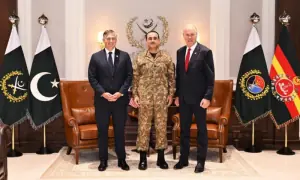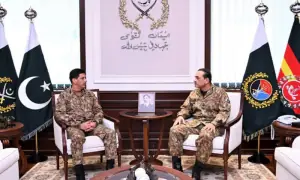
THE media hype surrounding recent appointments to top slots in the army and the ISI, ironically coincided with the state-owned PIA practically grounding its ATR planes for checks following the crash of the ill-fated flight PK-661 from Chitral to Islamabad.
The coincidence of these two events was a powerful reminder of a national obsession with routine changes in the armed forces, while real-life issues that will define Pakistan’s future remain partially or fully neglected. It also points towards Pakistan’s failure to appreciate the downward drift in the country’s outlook with ultimate consequences for national security, notwithstanding Prime Minister Nawaz Sharif’s government repeatedly predicting a coming economic ‘take off’.
The trouble surrounding the national flag carrier is just one of the many examples of the rapid decay in Pakistan’s public-sector companies after becoming larger-than-life white elephants. The failure under successive regimes to stem the rot while Pakistan’s leaders repeatedly promised to leave no stone unturned in defending the country’s security must count among the biggest ironies in the nation’s history.
Exactly what will decide the fate of Pakistan’s security? Is it just halting of the advance by militants who at one time practically ruled parts of the country and whose influence still persists, or is it more centrally the fate of Pakistan’s mainstream population? Tragically, those compelling questions have never been robustly addressed by successive regimes which ought to have been the first step towards a long overdue national revival. Ultimately, Pakistan’s huge security challenges have only become increasingly acute with the passage of time. The fundamental flaw in tackling those challenges has been the failure to appreciate exactly how Pakistan’s best interests need to be protected, beyond fighting the fight in a military style.
Exactly what will decide the fate of our security?
And while the headlines continue to be grabbed by exactly what brought down the ill-fated flight PK-661, the multiple maladies that have brought down PIA and turned it in to a white elephant need to be aggressively examined. Whether it’s the case of PIA’s two hotels in Paris and New York which should have been sold long ago to rescue its core business, or why the boilers in ATRs collapsed long ago leaving passengers without hot drinks, the list goes on and on. A similar set of issues stands at the heart of other failed or failing state institutions such as Wapda or the Pakistan Steel Mills or Pakistan Railways. Their history of balance sheets along with the general state of affairs in any one of these institutions is an indication that the government has no business to be in business.
Meanwhile, key services for the people which ought to be at the centre of the state’s responsibilities, notably education and healthcare, remain neglected. And there’s also a dark side to the security gains, so proudly pronounced by Pakistan’s leaders as evidence of success. While militant sanctuaries were clearly attacked in army campaigns especially in the past two years, policing in urban and rural areas all across Pakistan presents yawning gaps that have been left unattended. The clear politicisation of Pakistan’s police and the loss of independence of decision-makers across the board have turned a once reasonably functioning institution in to a series of fiefdoms controlled by local influentials.
Meanwhile, the findings of the inquiry commission of the well-respected Justice Qazi Faez Isa probing the Aug 8 terrorist attack in Quetta, marks a powerful reminder of where lies the rot. Contradictions between words and deeds such as Interior Minister Chaudhary Nisar Ali Khan’s reported meeting with a head of a banned outfit, says much about Pakistan’s direction. Unless key functionaries from top level leaders to those in the field learn to become law-abiding, no amount of work otherwise to enforce the law will bring sustainable change across Pakistan.
And last but not the least, in sharp contrast to frequent claims of Pakistan heading towards economic rehabilitation, the reality on the ground presents a compelling case to the contrary. The collapse in Pakistan’s agricultural incomes notably in the past two years and a decline in exports marks a twin whammy for economic growth.
The evidence from the ground clearly suggests that the majority of the population which relies on agriculture and industry is nowhere even remotely close to seeing the spin-offs from a recovery often bragged about in official claims. These contradictions have tragically coincided with little evidence of the ruling structure becoming more focused in aggressively tackling the mother of all economic ills, namely widespread tax evasion across Pakistan.
The challenges confronting Pakistan are multifaceted but the contradiction at the centre of Pakistan’s sorry outlook is just one. The country’s ruling structure must lead by example, defining security through tackling issues that mainstream Pakistanis confront in their daily lives. Otherwise, the ground regained from militants will be in danger of being lost with the passage of time.
The writer is an Islamabad-based journalist.
Published in Dawn, December 27th, 2016