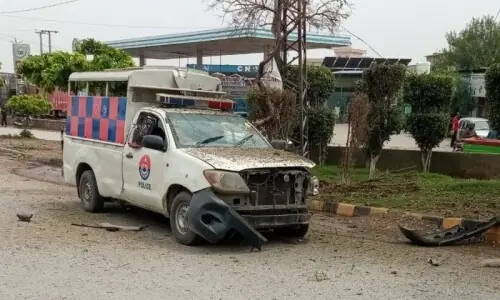
THE blight in Balochistan continues. This time a shrine in a remote, mountainous region of Khuzdar has been attacked and the death toll and number of casualties are devastating. It was the third monstrous attack in the span of three months – lawyers killed by the dozen in August; policemen killed by the dozen in October; and, now, members of the public killed by the dozen. The numbing scale of the disasters is difficult to process even in terms of a province that has been in the throes of every possible kind of violence for over a decade. Perhaps one day the people of Balochistan will be able to ask why they were cursed to suffer the violence of state and non-state actors alike, a macabre circularity that has seen them experience bloodshed in the name of security and insecurity.
Then post-attack rituals too are wearyingly familiar. In the immediate aftermath, the state stands exposed. Neither is the state able to deliver an acceptable level of security that prevents such devastating attacks nor is it able to quickly arrange for the kind of medical attention the victims require and material attention for the victims’ families. It usually takes the extraordinary intervention of senior government or military leaders for medical care to be made available. Afterwards, it does not seem to occur to that very same leadership that what is really needed are stronger institutions and better service delivery so that if — when — another attack occurs, medical care automatically swings into action. Difficult as it may be to strengthen institutions in the midst of long-term conflict, actual performance is so dismal as to call into question the very competence and priorities of the country’s leaders. As ever, it is the citizenry that has to suffer because of the leadership’s failings.
A day later, the devastation at the Shah Noorani shrine was already receding and a congratulatory narrative taking its place because of the Gwadar port inauguration. To be sure, the potential for the economic uplift of the Gwadar region, much of Balochistan and the country itself ought to be highlighted. It is possible that the trade and transit potential of the country is on the verge of receiving a transformational boost. But security and prosperity are intrinsically linked and if the benefits of economic growth are to be equitable and fair, surely swathes of Balochistan cannot be allowed to remain under the threat of militant violence of every hue. It seems that the only constant in Balochistan is violence — political and military leaders have come and gone with several already forgotten, but somehow militancy and endemic violence appear to have found a way to normalise themselves.
Published in Dawn, November 14th, 2016