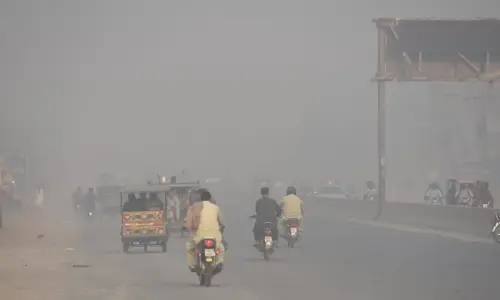
LAHORE: A blanket of smog which had been hovering over Lahore in the last few days thickened on Wednesday, causing thousands to complain about breathing problems, eye irritation and reduced visibility on roads.
The Met Office has released a weather warning describing the smog — comprising nitrogen oxide, carbon monoxide, sulphur dioxide and other aerosols — as a result of cold high pressure in the upper atmosphere.
The office states that suspended matter accumulates in the lower atmosphere, colliding with water vapour which causes a chain reaction that produces smog.
The duty forecasting officer said this weather was likely to persist for the next two or three days in Lahore, Islamabad, Rawalpindi, Jhelum, Gujranwala, Faisalabad, Okara, Sahiwal, Pakpattan, Multan and Khanewal districts.
People may experience eye irritation, respiratory problems and skin irritation. Road and air traffic could be affected due to low visibility, the Met Office has said.
Urban areas were worst hit by smog in winter, said Nasimur Rehman, an Environmental Protection Agency (EPA) official who used to be based in Lahore.
The situation is particularly bad at Yateem Khana Chowk, Azadi Chowk, and the busier traffic junctions in the city. “The World Health Organisation has set the benchmark for suspended particulate matter at less than 150 micrograms per cubic metre. In these areas, it can exceed 270.”
Long hours of traffic jams, especially on the main arteries of Lahore, including The Mall and the Canal Road, can trigger a smog situation. Mr Rehman added that factories, inside and around the city, also aggravated pollution levels. “Especially when they end up burning rubber for fuel because of a shortage of availability of natural gas.”
Emissions from factories and cars result in high levels of sulphur dioxide, nitrogen oxide and carbon monoxide, the three main gases that contribute to dangerous levels of air pollution.
Rafay Alam, an environmental lawyer, said there was no precise empirical evidence of air quality in the city because either the government did not have the necessary equipment, or it did not make use of it.
He said there was always more pollution in winter, because of low wind levels and high particulate matter. To add to the problem, Alam said, the EPA had been in “disarray” since its director general was sacked recently.
Syed Nihal Asghar of Seal Laboratories said his firm owned air quality measuring equipment. “We measured air quality on Wednesday morning when the level of carbon monoxide was 4ppm (parts per million), it rose to about 5ppm in the evening. It should be less than one ppm.”
The EPA had been given measuring instruments by a Japanese firm and they had been installed in some places including the Town Hall and Regal Chowk, but workers had not been trained to operate them and the machines just rusted away.
He added that coal factories were mostly upwind and when the direction of the wind changed, both Lahore and New Delhi were affected. “The wind has pushed the particles and gases into Lahore, and for now, it is trapped within city limits.”
Dr Awais of Mayo Hospital’s ENT Ward said most patients had visited the hospital on Wednesday complaining of severe breathing problems. “We suggest that people, especially those on motorcycles, cover their noses and mouths and wear protective glasses and helmets.”
Dr Nasim said the traffic police would have to take extraordinary measures to control traffic jams and factories would have to take care not to burn plastic, wood or rubber for fuel.
Chief Minister Shahbaz Sharif formed a high-level committee to monitor the issue and announce precautionary measures.
The committee will look into an emergency plan in view of the smog. It will also issue guidelines for schoolchildren and preventive measures in case of traffic accidents.
The initial report is to be presented to the CM on Thursday.
Published in Dawn November 3rd, 2016