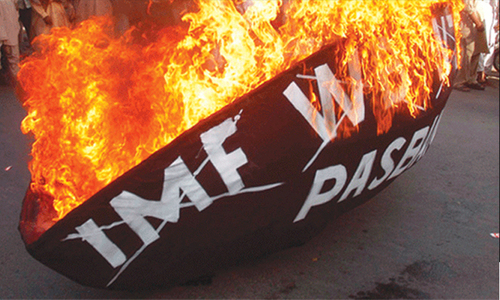
Now that the latest IMF programme has concluded, a few questions must be asked.
First, is this the last Fund programme for Pakistan? In the last 27 years, there have been only six in which Pakistan did not draw any resources from the Fund, making the country a “prolonged user” of IMF resources to use the Fund’s own parlance.
Something critical is broken in the economic machinery of the country; it is a defect that has sent the country back to the IMF in a constant and never-ending cycle, and the emergency lender’s facilities have been used more like an ATM than the emergency room that they are supposed to be.
The mission chief pointed towards the substantial reserves held by the country, as well as improvements in the power sector such as improved recoveries and greater efficiency as key achievements under the programme. He also mentioned improved revenue generation.
But given the yawning deficits on the external front, and the near-total absence of any structural reform of public-sector enterprises or the tax machinery, which has mobilised the increased revenue largely by squeezing existing taxpayers rather than netting in new ones, it is highly uncertain that the present moment of relative stability will last very far into the future.
This leads us to the second natural question: how deep are the changes that the Fund programme has wrought in the economy?
Granted three years is far too limited a time to change the underlying fundamentals of any economy — its revenue base, structure of exports, patterns of consumption etc — but how much headway has been made in earnest?
Pakistan’s competitiveness has not improved appreciably over this period; in fact, exports have shrunk, reliance on remittances has gone up, and while the structure of public finances may have increased in quantum, it has not in quality. The economy has been stabilised, but indebtedness has grown. This is not an end-state to be happy about.
At the end of the day, it is important to realise that the IMF cannot want reform in Pakistan more than the authorities themselves do. If there is a deep and widespread inability and unwillingness to reform the state and its relationship with the institutions and stakeholders of the economy, then that stasis cannot change from external inducement.
Pakistan has historically used the IMF as an ATM machine, drawing resources and walking away, and that pattern has not changed materially. This has been made possible by a stasis in the political economy at home, coupled with a geopolitical imperative from abroad, where the great powers do not wish to unplug the country from global markets for fear of the consequences this could have for Pakistan’s stability.
The programme may have ended, but its history and the endless cycles of Fund programmes are likely to be repeated.
Published in Dawn, October 15th, 2016