Expectant mothers vulnerable


 0
0

Family members and neighbours began to wail as the body of a woman, who died of childbirth complications, reached her house in Ismail Bandi village of Shergar union council in Oghi tehsil.
“The deceased, the mother of five, was anaemic, so the failure of the daaye (untrained attendant) to check heavy bleeding during obstetrical delivery led to the woman’s death,” a visitor told Dawn.
In Mansehra, the incidence of such deaths is higher compared to other developed districts in Khyber Pakhtunkhwa.
According to the relevant officials, 143 women and 34 infants died in Mansehra from delivery complications in 2014 as unskilled birth attendants handled those cases, while such problems killed 143 women and 33 babies in the district in 2015.
Though several mother-child projects are underway, the maternal and infant mortality rate in Mansehra is very high as only half of the two million population is covered by the mother-child healthcare programme with the rest at the mercy of unskilled birth attendants, including untrained midwives, quacks and faith healers.
The health department records show 81 percent of childbirths in Mansehra were carried out by skilled birth attendants in 2014but the rate went down to 78 percent next year.
The lady health workers programme meant to create awareness among pregnant or other women of pregnancy and childbirth hazards at the hands of unskilled attendants has not covered the entire district. Of a total of 138 health facilities in the district covering both lactating and pregnant women, LHWs are posted to 51 only.
According to the health department, the mother and infant mortality rate is relatively much higher in remote and inaccessible areas of Mansehra as the people prefer unskilled and untrained daayes for delivery of babies.
An LHW said the visit of women to health facilities was a social taboo in the district, especially in rustic areas, by and large.
“Even after undergoing regular medical checkups, pregnant women are reluctant to avail themselves of health services at hospitals due to the opposition of family members, especially husbands and in-laws,” she said.
The LHW said expectant women were denied proper diet and thus, causing anemia and pregnancy and childbirth complications, mostly fatal.
“It is mandatory for a woman to visit doctor for checkup eight times during pregnancy. Such checkups are necessary to prevent childbirth complications but our women prefer to go to faith healers and not doctors,” she said.
The LHW said many doctors and skilled birth attendants went for normal childbirth to make money despite knowing that pregnant women were anemic.
With a population of around two million, Mansehra needs at least 400 community midwives. However, the district has just around 70 skilled birth attendants.
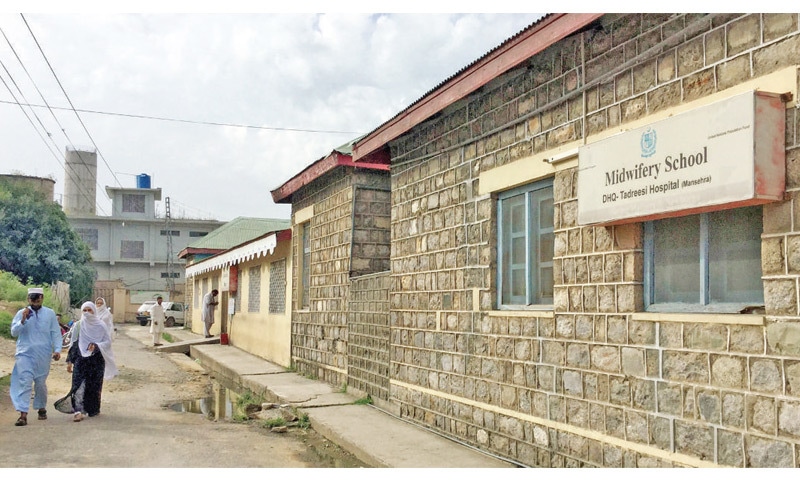
The United Nations Population Fund had established a midwifery school at the King Abdullah Teaching Hospital in Mansehra in 2008 to train girls with at least matriculation degree as midwives in a bid to reduce the mother and infant mortality rate in remote parts of the district.
However, the school has been closed since 2012 when it was handed over to the health department.
“We want to run this midwifery school as we know if we produce skilled manpower and induct them in health centres of far-off areas, we will be able to bring MIMR down to zero or close to it. However, we are short of funds,” Mansehra district health officer Shahzad Khan told Dawn.
The DHO said the health department was striving to address the reasons for pre- and postnatal deaths but social taboos, lack of access to their respective areas and weak referral system were major hurdles.
“We receive the data of maternal and infant mortalities from our lady heath supervisors in regular monthly conferences and have discussion on it before adopting preventative measures,” he said.
The number of pregnant women visiting government facilities for examination has almost doubled over the years, especially in the wake of the government’s mid-2015 initiative to make payments for such visits, deliveries and infant vaccination.
In 2014, 3,080 expectant women got themselves registered with government health centres but only 494 of them delivered babies there.
However, the number surged to 6,931 in one year after the launch of the CM Initiatives for Mother and Child Health. A total of 998 babies were delivered at government health centres in the district.
“In the first two quarters of the current year, a record number of pregnant women i.e. 5,419 visited public health facilities in Mansehra. A total of 717 childbirths have been delivered there,” said Siyar Khan, the focal person of the CM programme.
He said the number of visitors and childbirths at government health facilities was gradually on the rise.
Mr. Siyar said 850 LHWs had been working in Mansehra with 28 lady health supervisors overseeing them.
“Our LHW programme covers almost one million population with the sensitisation of pregnant and other women to their healthcare continuing all through the year. The preventive measures have led to the decrease in the mother and infant mortality rate,” said Shahid Lodhi, the focal person for the LHW programme in Mansehra.
He said the rate of childbirths at the hands of unskilled attendants was 19 percent in 2014 but it rose to 22 percent last year due to the ‘widening of our coverage area’.
Mr. Lodhi said LHWs besides visiting pregnant women also compiled data of pre- and postnatal deaths in their respective areas that was verified by lady health supervisors and assistant district coordinator by visits.
Published in Dawn, September 4th, 2016