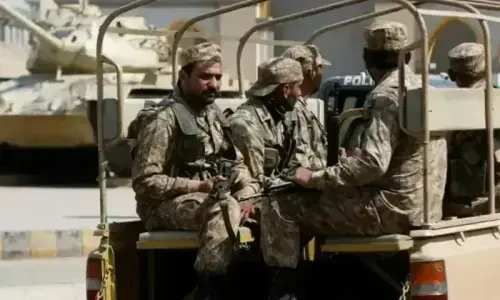
ISLAMABAD: The Parliamentary Committee on China Pakistan Economic Corridor (CPEC) was informed on Friday that a Special Security Division (SSD) comprising 9,000 Pakistan Army soldiers and 6,000 para-military forces personnel has been set up for the security of the project and individuals working on it.
”Special Security Division has been entrusted with the duty of protecting Chinese workers and projects under CPEC,” officials of ministry of defence said while briefing the parliamentary panel on Friday.
The remarks were made in an in-camera meeting of the committee on CPEC, which was chaired by Senator Mushahid Hussain.
The committee was being briefed by the ministry of defence and the ministry of interior on security of CPEC and the various steps taken by the government for the protection of Chinese nationals and projects under the CPEC.
The government has also allocated Rs1.3 billion for CPEC security in addition to the efforts of provincial governments, the committee was informed.
“The cost of raising the SSD was Rs0.5 billion and it took a year to be raised,” the officials said.
“Apart from security on land, the government has also taken relevant initiative through the maritime security agency to protect the coast as well as through the Pakistan Air Force,” added the officials.
CPEC: Background
The CPEC is a 3,000-kilometer network of roads, railways and pipelines to transport oil and gas from Gwadar Port to Kashgar city, northwestern China's Xinjiang Uygur autonomous region, China Daily reports.
Proposed by Chinese Premier Li Keqiang during his visit to Pakistan in May 2013, the CPEC will act as a bridge for the new Maritime Silk Route that envisages linking three billion people in Asia, Africa and Europe.
An official agreement on the corridor was signed between the two countries in May this year during President Xi Jinping's historic visit to Pakistan.
A flagship project of the Belt and Road initiative as well, the CPEC intends to revive the ancient Silk Road with a focus on infrastructure, and constitutes the strategic framework of bilateral cooperation.
The project links China's strategy to develop its western region with Pakistan's focus on boosting its economy, including the infrastructure construction of Gwadar Port, together with some energy cooperation and investment programs.
It also involves road and railway construction including an upgrade of the 1,300-km Karakoram Highway, the highest paved international road in the world which connects China and Pakistan across the Karakoram mountains.
The CPEC will reduce China's routes of oil and gas imports from Africa and the Middle East by thousands of kilometers, making Gwadar a potentially vital link in China's supply chain. Controversy over CPEC routes
The project has generated controversy with political leaders particularly of smaller provinces alleging the project has been altered to benefit Punjab, who criticise the western route being inagurated first.
The route, which includes the Gawadar-Kashgar road, has been designed for heavy transportation so it benefits local as well as international trade that will flow through it.
The eastern route, meanwhile comprises motorways from Gwadar to Sukkur to Multan and then to Lahore and further.
Critics say that different specifications of the two routes will automatically dictate the transporters' first choice, resulting in the use of eastern route as the only use.
The route apparently under its original plan ran from Gwadar to Quetta, then up to Zhob before veering east towards Dera Ismail Khan.
The government changed this route to go straight east from Gwadar towards Khuzdar, then slightly northeast to cross the River Indus near Ratodero and connect with the road network in Sindh, a decision that was heavly criticised.
The government strenuously denied that any route changes were made, arguing that both the eastern and western routes are being pursued, and on the request of the Chinese, the second route is being built first simply because it is cheaper to do so.