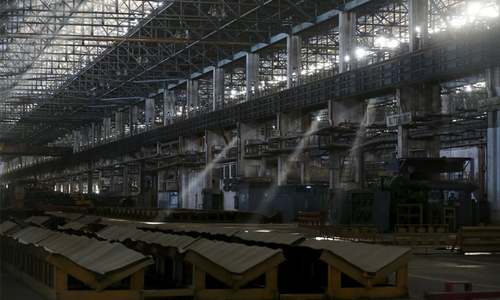
ISLAMABAD: In what appeared to be a last blow, the Privatisation Commission has stopped Pakistan Steel Mills (PSM) from selling its scrap and product inventory being used to meet day-to-day expenses.
The country’s largest industrial unit is already on “zero production heat mode” since its gas supply was drastically cut on June 10, 2015 (more than 13 months now) while its competitors around the world make roaring business having more than $3 billion steel imports into Pakistan in fiscal year 2015-16.
The zero production mode has pushed PSM losses and liabilities beyond Rs385 billion that stood around Rs200 billion when Pakistan Muslim League-N government assumed power in May 2013 elections.
“Pakistan’s only steel producing unit is suffering the worst condition of its history,” said a senior official.
Since January this year, the monthly pay bill of the company has been scaled down to about Rs380 million from around Rs600 million through gradual reduction in its staff strength. The salaries are generally being paid to the staff with 4-6 month delay on humanitarian grounds out of federal budget as a loan. The February-March 2016 salaries were approved by the Economic Coordination Committee of the Cabinet just ahead of Eidul Fitr.
“PSM may refrain from sale of any inventory, including scrap and strictly adhere to the content of my letter of Jan 14, 2016,” wrote chairman privatization Mohammad Zubair to the secretary of Industries and Production.
This came when the Ministry of Industries and Production, the parent ministry of the PSM, allowed the PSM’s interim management to sell its scrap to meet its day-to-day unavoidable expenses.
“The ministry of Industries and Production may kindly ensure the applicability of my letter dated Jan 14, 2016, and may also immediately withdraw its letter dated June 2, 2016,” ordered Mr Zubair.
The blockage of funds is understood to create some humanitarian problems, like water supply, electricity, emergency medical services and transport.
Some of these expenses included electricity bills payable to K-Electric, Karachi Water and Sewerage Board payments, gas bills of Steel Town, transport fuel bills, medical expenditures, food shop subsidiary, teachers’ salaries, coke oven battery foreign staff from Ukraine, expenditures and salaries, EOBI, Port Qasim jetty taxes, transport maintenance expenditures are all necessary day-to-day expenses needed to run the plant and office works.
These all expenditures were previously met by PSM by selling some finished products and scrap as the Economic Coordination Committee (ECC) of the cabinet is only approving salaries of the employees.
The retired employees and the families of deceased employees have not yet been paid their provident funds and gratuity since 2013.
On Jan 14, 2016, Chairman, Privatisation Commission, stopped the PSM from selling finished product inventory sale which were later allowed by the Industries Ministry on humanitarian grounds to avoid public outcry.
For more than a year now, the federal government has refrained from taking a strategic decision about the future of Pakistan Steel Mills on the pretext of its offer to Sindh government to take over the entity even though the provincial government was on record denied to have ever expressed any such desire.
This happened when the financial advisers hired by the government had estimated increasing the production capacity from one million tonnes to three million tonnes with an investment of Rs90 billion to make it profitable given big steel market in Pakistan. The advisers had predicted that with China-Pakistan Economic Corridor taking off, the PSM could become profitable in one year.
Published in Dawn, July 13th, 2016