THE National Assembly, a representative body whose members are elected by the citizens of Pakistan, is in many ways a microcosm of the country.
On Wednesday however, it manifested one of the worst aspects of our society — that is, the deep vein of sexism that runs through it, constantly undermining women and pushing them to the sidelines.
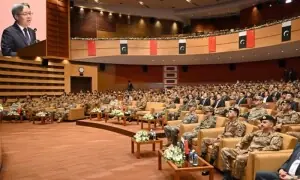
The occasion was the budget debate in the house when, faced with the opposition’s robust response to his claims, Water and Power Minister Khawaja Asif let loose a tirade containing some extremely derogatory remarks against PTI’s chief whip Shireen Mazari.
An uproar ensued from the opposition benches who demanded an apology from the minister. However, instead of doing so forthwith, he refused to oblige.
Speaker Ayaz Sadiq intervened but only to suggest that Ms Mazari had ‘asked’ for it, and that he would expunge the remarks but only if she sat down.
While the minister, the speaker — who deserves censure for reinforcing the blatant misogyny on display — and undoubtedly many others in the Assembly may consider such remarks as being unworthy of second thought, or even as clever ripostes, they are anything but.
Although there has been of late a perceptible lowering of standards in terms of the language used by legislators — with Khawaja Asif a repeat offender on this count — the latest instance is particularly troubling. For it feeds into the narrative which holds that women do not belong in the public sphere and that those who do venture out are fair game for harassment and abuse.
These are notions with insidious and far-reaching consequences for women’s agency and autonomy, particularly with respect to their right to work, vote, choose a life partner, etc.
Even if they are representatives of this chauvinistic society, our legislators have a duty to ensure that they rise above their inherent impulses, instead of irresponsibly perpetuating gender stereotypes.
And that goes for women legislators as well, several of whom on occasion exhibit the tendency to use gender-biased language, a classic example of women themselves internalising prevalent misogynistic rhetoric.
Despite a number of pro-women laws enacted in the last few years, Pakistan’s political arena remains unabashedly patriarchal.
This is evident in male politicians’ often dismissive attitude towards their female counterparts, not only in the frequently adversarial atmosphere of parliament — as on Wednesday — but also within their own parties.
Moreover, its merits aside, the system of reserved seats for women reinforces the impression that those elected to them are there on the sufferance of men, even though statistical reviews of parliamentary performance show that the former consistently outperform the latter in several respects. Women legislators must work across the aisle to build a united front.
No amount of legislation can substitute for actions that demonstrate respect for women’s voices in parliament, not as an indulgence but as a right.
Published in Dawn, June 10th, 2016