0
0

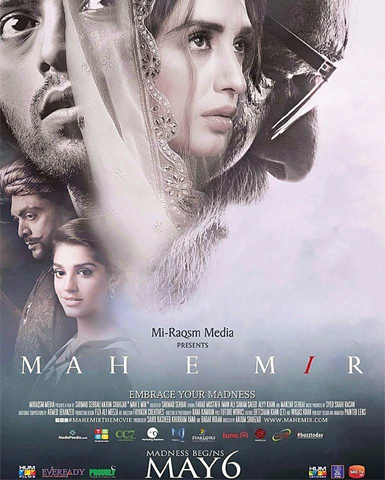
Director Anjum Shahzad believes that Mah-i-Mir’s scope is bigger than box office glory, and he took it up as a challenge and a chance to work with its writer Sarmad Sehbai. “The conviction that a true film-maker seeks within himself comes directly from the script, as the latter has to be gripping and appealing, regardless of how much it may earn at the box office. When Mah-i-Mir came my way about three years back, I was glued to its narrative immediately, for I have been somewhat of a student of Urdu poetry and literature myself. Moreover, I haved admired Sarmad Sehbai as a literary figure for a long time now, so it came as an opportunity to execute and interpret his vision, and it convinced me to go ahead with the project right away.”
Fahad Mustafa dominates the first half as an out-of-favour Jamal, and makes his presence in the film post-interval as both Jamal and Mir Taqi Mir. “Fahad is one of the finest and thinking actors we have today in the country. His method of acting is quite his own, because he tends to live the character he is trying to play on screen. I think he was able to pull off a brilliant performance because of his dedication to the craft of ‘method acting’ that he has immersed himself in. He has worked with me on television, so we developed the (actor-director) chemistry immediately. I am happy that it paid off, as the response to his performance speaks for itself.
“Mah-i-Mir brings into limelight our rich tradition of classical Urdu poetry in a manner that is relevant to our society. I’d call it an attempt to revive Urdu poetry and diction on the silver screen. In this post-modern age of technology and specialisations, our lives have become so fast-paced that our cultural legacy and lingual tradition are lagging behind, as 60 per cent of the under-25 populace is unaware of who we are and where we come from as a people. I hope Mah-i-Mir proves to be a stepping stone in that direction,” says the director.
The film also marks the debut of Bollywood and Hollywood actor Alyy Khan who has been active on TV circuit, but not films. The actor, who shared the screen with Shah Rukh Khan in Don 2 and will be seen in action in Nabeel Qureshi’s Actor in Law, plays the role of a nawab who doesn’t want to share his affection for Mehtab Begum (Iman Ali). However, Iman Ali looks bored in the role and doesn’t impress as much as Sanam Saeed, who delivers a short yet flawless performance as the poetess who intimidates Jamal’s character. She may not be as beautiful as Iman, but her pronounciation is flawless and she doesn’t disappoint. Also, the leading lady’s costumes seemed awkward for the 18th century as the earliest form of the zipper was invented much later in 1851!
Anjum credits the correct diction and pronunciation to his actors, as well as the writer Sarmad Sehbai. “All the actors worked really hard; Fahad worked tirelessly on his Urdu by constantly inquiring on the pronunciation, nuances and meaning of words and verses that he found himself confused about. Sarmad Sehbai was ever-present at the readings and rehearsals, as he made sure everybody understood their Urdu well. It was an exciting experience for all of us in a way that we got to learn a lot about Urdu and Mir’s poetry during the course of this project.” Mah-i-Mir might not strike gold at the box office, but one thing is certain; it has brought Mir back into our lives.
The director concludes by saying that his film is a success, irrespective of the box office. “My film is about acquired taste … we only like things that we’ve acquired a taste for in life. If Mah-i-Mir doesn’t do well, it will be because people aren’t used to watching serious cinema. Thinking cinema demands its audience to participate actively, but it is cinema nevertheless. My next films — Zindagi Kitni Haseen Hai and Band To Ab Bajay Ga — are different from Mah-i-Mir, and I hope that they also contribute to the rebirth of cinema in Pakistan.”
Published in Dawn, Sunday Magazine, May 15th, 2016