UNITED NATIONS: The Oscar-winning Pakistani documentary, “A Girl in the River” by Sharmeen Obaid-Chinoy, was screened at the UN at a packed-to-capacity hall.
It was organised by the Pakistan’s mission to the UN and co-sponsored by UN-Women in conjunction with Equality Now. As a side event during the 60th annual session of the Commission on Status of Women (CSW), the film and a panel discussion which followed attracted an audience from various countries.
Members of the Pakistan delegation, currently in New York to represent the country at CSW meetings, were also present.
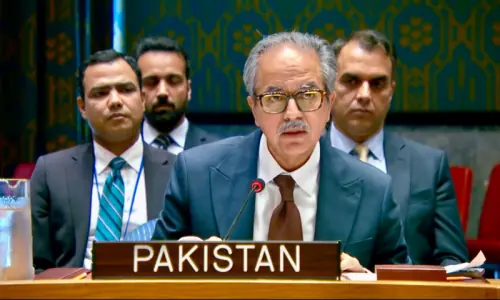
Pakistan’s Ambassador to the UN Dr Maleeha Lodhi introduced Raheela Durrani, the country’s first woman speaker (of the Balochistan assembly).
The Pakistani envoy’s main message at the event was that while Pakistan faced challenges in improving the status of women and ending harmful practices and crimes such as honour killings, it had also produced extraordinary women who had broken the glass ceiling to reach the top of their professions, a press release said.
Speaking as a panelist, Phumzile Ngucka, executive director of UN-Women, said that honour killing was a complex issue which needed a comprehensive response from all segments of the society and emphasised the need for pro-women legislation. She also praised Prime Minister Nawaz Sharif’s commitment to leading this effort.
The film was much appreciated by the audience who engaged in lively panel discussion and question-answer session that was moderated by Ms Yasmeen Khan of Equality Now.
In her opening remarks in the discussion, Dr Lodhi said the presence of so many people from different parts of the world at the event would ensure that the message of the film would be disseminated far and wide. “And I am sure this is what Sharmeen would have wanted,” she added.
She recalled that Prime Minister Sharif had said after watching the film that customs and practices like honour killings had nothing to do with the divine principles of Islam and that his government would adopt all possible means to remove this stain from our society.
Responding to a question on the role of the media, Ambassador Lodhi said that it had a pivotal role to play in changing mindsets. She also said that the education of both girls and boys was necessary to bring about a change in social attitudes, and that the economic empowerment of women was the key to their ability to take control of their destinies and act as independent actors.
Published in Dawn, March 17th, 2016