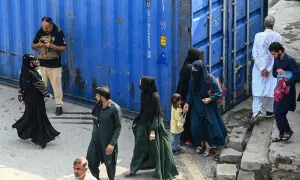
ISLAMABAD: Despite increasing the education budget and making several national and international commitments, the federal and provincial governments have still failed to bring about major breakthroughs in bringing out-of-school children to school.
Pakistan has the second highest concentration of out-of-school children in the world after Nigeria. The country has failed to deliver even an exact figure of out-of-school children, and there are conflicting figures ranging between six and 25 million.
According to the Annual Status of Education Report-ASER 2015 national survey, 20 per cent of children between six and 16 are out-of-school across the country. The survey also showed that the remaining 80 per cent of (enrolled) children in the same age bracket are not learning much.
It stated that just over half the children enrolled in fifth grade can read stories in Urdu, Sindhi or Pashto, 51 per cent cannot read sentences in English, and 50 per cent cannot do two digit division.
The report, which was launched on Thursday, stated that the proportion of out-of-school children has decreased slightly as compared to 2014. This year, 20 per cent of children were reported to be out-of-school, which is a decrease from 21 per cent in 2014.
In addition, 14 per cent of children between six and 10 have never been enrolled in school and six per cent have dropped out.
At the launch State Minister for Education Balighur Rehman said the report is encouraging improvement in the education sector. “Until we [are introspective] we cannot progress,” he said. He added that significant improvement had been made in the sector, and efforts for further improvement were ongoing. He said that 6.1 million children were out-of-school, which he said was a matter of concern.
National Party president Mir Hasil Bizenjo said that poor children who could not afford school educations had instead turned to religious seminaries, and emphasised the need for an increase in the education budget.
The survey revealed that 16 per cent of surveyed public sector primary schools do not have drinking water facilities, while 48 per cent do not have toilet facilities. In addition, 37 per cent of primary schools are reportedly functioning without boundary walls.
ASER’s findings also revealed an interesting trend this year – the 2015 results have shown a considerable number of students enrolling in public schools as compared to non-state schools. According to the survey, 76 per cent of children (between six and 16) were enrolled in public schools, an increase from 70 per cent in 2014.
The report said that children enrolled in private schools were outperforming students from government schools. Moreover, 67 per cent of fifth graders from private schools were able to read a story in Urdu, Sindhi or Pashto, compared to 52 per cent from government schools.
The difference in learning levels is starker for English, where 65 per cent of fifth graders from private schools could read English sentences compared to 45 per cent from public sector schools. For arithmetic, 61 per cent of private school students from the fifth grade could do two digit division compared to 47 per cent of students enrolled in government schools.
The survey was conducted by 10,000 volunteers, managed by Idara-e-Taleem-o-Aagahi (ITA) and other civil society and semi-autonomous organisations, including the National Commission for Human Development (NCHD), Sindh Education Foundation (SEF), Democratic Commission for Human Development (DCHD) and other organizations across Pakistan.
Its findings are based on information about 258,021 children between three and 16 years of age. The information came from volunteers who personally visited 83,755 homes in 4,217 villages from 146 rural districts and 21 urban areas across the country.
Published in Dawn, December 18th, 2015