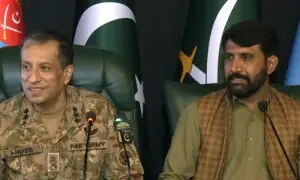
QUETTA: The Chairman of the Senate standing committee on interior and narcotics control, Rehman Malik, alleged on Tuesday that India was a main hurdle in normalisation of Pakistan-Afghanistan relations.
Speaking at a press conference here after a meeting of the committee, he said that the Indian leadership and intelligence agencies did not want Pakistan and Afghanistan to resolve bilateral issues through talks.
The members of the committee, including Senators Shahi Syed, Tahir Hussain Mashhadi and Kulsoom Perveen, and Balochistan Home Minister Sarfaraz Ahmed Bugti were present.
Mr Malik’s allegations came on the day when Indian External Affairs Minister Sushma Swaraj arrived in Islamabad to attend the Heart of Asia conference.
Take a look: Malik warns against plot to create East Pakistan-like situation
He alleged that Indian intelligence agency, Research and Analysis Wing (RAW), was involved in terrorist activities in Balochistan, the Federally Administered Tribal Areas and Karachi.
He urged the government to take up the issue of Indian interference with the Indian minister and show her evidence of RAW’s involvement in terrorist activities in Pakistan, that had been handed over to United Nations Secretary General Ban-ki Moon. He said that Pakistan should raise Kashmir and water issues at the conference.
“Whenever Pakistan makes efforts to open talks with Afghanistan to resolve issues involving the two counties, Indians create hurdles,” Mr Malik said.
He said that Pakistan and Afghanistan were brother Islamic countries and peace was necessary for both of them.
“A peaceful Afghanistan is needed for a peaceful Pakistan,” he said, adding that the latter had rendered sacrifices to restore peace in Afghanistan and extended help and cooperation for reconstruction in the war-torn country.
As Afghan President Ashraf Ghani was also going to attend the Heart of Asia Conference, it would provide an opportunity to the two countries to find out solution of issues involving both.
He said that the conference would bring Pakistan, Afghanistan and India closer to each other and pave way for resolving bilateral issues.
The chairman and members of the Senate committee expressed satisfaction over law and other situation in Balochistan and said that it had improved to great extent.
Credit for that went to civil- military cooperation, implementation of the National Action Programme (NAP) to counter terrorism and Chief Minister Dr Abdul Malik Baloch and his coalition government, Senator Malik said.
“Balochistan has emerged a role model for other provinces in implementation of NAP.”
In the past, he said, the province had been plagued with terrorism but the provincial government had taken effective steps to control the situation.
Published in Dawn, December 9th, 2015