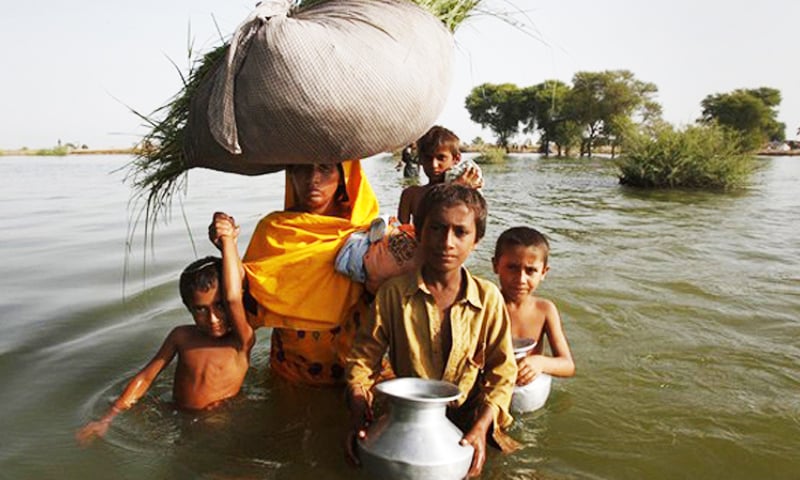

ISLAMABAD: The government estimates that Pakistan has, collectively, suffered losses to the tune of $20 billion due to the adverse and increasing effects of climate change.
In a detailed report submitted before the National Assembly on Friday, the government also accepted – in so many words – that “Pakistan is among the countries which are most vulnerable to climate change, and has a very low technical and financial capacity to adapt to its adverse impacts”.
The more immediate and pressing task for the country was to adapt itself to this climate change, the government said.
Also read: Climate change and malnutrition
In a written reply to a question put to the Ministry of Climate Change by PTI’s Rai Hassan Nawaz Khan, the government stated that coastal and marine environment, dry land ecosystems, agriculture and livestock sector, forests, biodiversity and health were among the sectors that had been seriously affected by climate change.
PM yet to appoint new minister after Mushahidullah’s departure in August
It noted that the phenomenon also posed a major threat to food, water and energy security in the country, since it induced the melting of glaciers, cyclonic storm surges, tropical diseases and epidemics, flash floods, droughts and variable monsoons, which had become “an inevitable reality for Pakistan over the past many years”.
However, the government’s lack of regard for the potentially devastating impact of increasingly erratic weather patterns is reflected in the fact that since the resignation of former climate change minister Mushahidullah Khan in August, Prime Minister Nawaz Sharif has yet to find a suitable replacement for him. The senator was asked to resign following a controversial interview with the BBC, where he is said to have commented about the army’s alleged role in last year’s PTI sit-in.
The report stresses that only by devising and implementing appropriate adaptation measures can the country ensure its water, food and energy security and minimise the impact of natural disasters on human life, health and property.
Rai Hassan had also asked if the government had conducted any studies to determine the negative impacts of climate change, but the reply only referred to an assessment of the changing weather patterns of Islamabad.
The assessment was carried out with the assistance of UN-Habitat, the Capital Development Authority and the ICT Administration and called the “Climate Change Vulnerability Assessment of Islamabad”. Launched on World Environment Day, June 5, the study reveals that the capital and its surrounding territories were exposed to a host of factors that accelerated the impact of climate change, such as marked changes in the intensity, frequency and variability of temperature, precipitation, floods, droughts and other weather systems.
“The extreme weather events recorded so far in Islamabad include the highest maximum temperature of 46.6 degrees Celsius on June 24, 2005, and lowest at -4.3 degrees on Dec 25, 1984. In 2001, the heaviest ever rainfall of 62.1mm was recorded over the course of 10 hours,” the report said.
The study proposed well thought-out interventions to make Islamabad a climate change-resilient city, but none of these has been implemented yet.
However, a number of cosmetic measures have been initiated in a bid to cope with the situation.
Realising the importance of the issue, government approved the National Climate Change Policy in 2012, but there has been no further progress on that front either.
Published in Dawn, November 9th, 2015
On a mobile phone? Get the Dawn Mobile App: Apple Store | Google Play