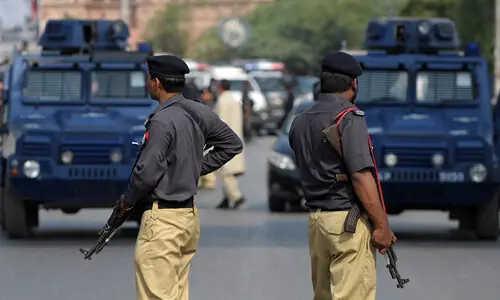
KARACHI: Senior Information Minister Nisar Ahmed Khuhro has said that the Rangers will be posted at sensitive and extremely sensitive polling stations in the second phase of local government elections, scheduled for Nov 19, while the Sindh government will request the Election Commission to ensure that army troops stay on standby.
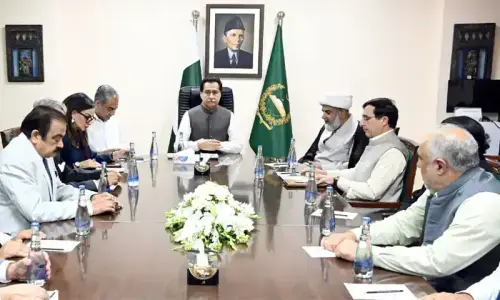
In the previous phase of LG polls, the Rangers were used for patrolling the vicinity of polling stations while this time the task will be assigned to the newly formed Rapid Deployment Force whose personnel will reach trouble spots within minutes after any untoward situation, according to the senior minister. Mr Khuhro expressed these views while talking to the media after presiding over a one-day programme titled “State of Right to Information in Pakistan” on Thursday.
The session, which was organised by the Pakistan Institute of Legislative Development and Transparency (Pildat) for provincial lawmakers and journalists,was also attended by Khyber Pakhtunkhwa information commissioner Abdul Matin Khan and Punjab information commissioner Mukhtar Ahmad Ali.
Earlier in his presidential remarks at the session, Mr Khuhro said work was under way to amend the outdated Sindh Freedom of Information Act, 2006, while the process for its approval by the assembly was being expedited. “The summary for amending the Right to Information Act has already been submitted to the chief minister,” the minister said. After approval by the cabinet, it would be tabled in the assembly as an amendment bill, he said.
In reply to a question, Mr Khuhro expressed the hope that Pir Pagara being a sober man would never adopt an undemocratic attitude on the Khairpur violence. He said the matter about taking revenge of the incident would not be taken up at his party meeting, as a case of the incident had already been registered against 27 people. All those involved in the incident would be arrested soon, he said, adding that a committee constituted by the government had already been investigating the incident under the supervision of an officer who enjoyed people’s confidence.
Legislation
The information minister exp-lained that the amended RTI law contained important provisions which would make it more responsive and effective in meeting public demand for official transparency and public accountability. He said information on government was available in Pakistan but there were problems related to consolidating the data and its use.
He was of the opinion that effective implementation of RTI was a slow process. “Making RTI more effective will require collaboration among citizens, the media and legislators.”
In Pakistan, he said, democratic governments were not allowed to run the affairs of the state while the media, too, remained under control. However, he said, Sindh was the only province where the media enjoyed freedom.
He highlighted the need of having website of every department for maintaining transparency and having access to the people about the department.
KP Information Commissioner Abdul Matin Khan, and Punjab Information Commissioner Mukhtar Ahmad Ali briefed the participants on what the new RTI laws in their respective provinces had achieved despite obstacles.
They also urged the media in Sindh to take part in the movement for RTI reforms.
Pakistan Mulsim League-Functional lawmaker Mahtab Rashidi, former information secretary, was of the opinion that there was lax attitude towards implementation of the RTI in Sindh. She said attention be given to the implementation of the existing Sindh Freedom of Information Ordinance, 2006, as every citizen had the right to know how public money was being spent.
While expressing concern over the state of RTI in the province, Dr Huma Baqai said that actions further than mere lip-service to the idea need to be undertaken by political parties. Senior journalist Mubashar Zaidi called for a new RTI law, citing that information from the government was the media’s bread and butter.
Earlier, Pildat joint director Aasiya Riaz opened the session while speaking about the significance of RTI law in improving the system of governance. She cited an example of Pildat’s request for an access to MNAs’ attendance record under the Freedom of Information Ordinance, 2002. She said it was due to the request under the information law that voluntary disclosure of the records later became a norm in the legislatures.
Published in Dawn, November 6th, 2015
On a mobile phone? Get the Dawn Mobile App: Apple Store | Google Play