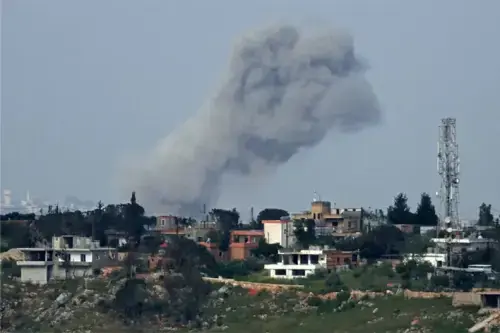
BEIRUT: Russia bombed targets in Syria for a third day on Friday, mainly hitting areas held by rival insurgent groups rather than the self-styled Islamic State (IS) it said it was targeting and drawing an angry response from the West.
The US-led coalition that is waging its own air war against IS called on the Russians to halt strikes on targets other than Islamic State.
“We call on the Russian Federation to immediately cease its attacks on the Syrian opposition and civilians and to focus its efforts on fighting ISIL,” said the coalition, which includes the United States, major European powers, Arab states and Turkey.
“We express our deep concern with regard to the Russian military build-up in Syria and especially the attacks by the Russian Air Force on Hama, Homs and Idlib since yesterday which led to civilian casualties and did not target Daesh,” it said.
ISIL and Daesh are both acronyms for Islamic State, also known as ISIS, which has set up a self-proclaimed “caliphate” across a swathe of eastern Syria and northern Iraq.
In Syria, the militant group is one of many fighting against Russia’s ally, President Bashar al-Assad. Washington and its Western and regional allies say Russia is using it as a pretext to bomb other groups that oppose Mr Assad. Some of these groups have received training and weapons from President Assad’s foreign enemies, including the United States.
President Vladimir Putin held frosty talks with France’s Francois Hollande in Paris, his first meeting with a Western leader since launching the strikes two days after he gave an address to the United Nations making the case to back Mr Assad.
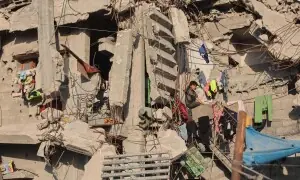
Friday prayers were cancelled in insurgent-held areas of Homs province that were hit by Russian warplanes this week, with residents concerned that mosques could be targeted, said one person from the area.
Warplanes were seen flying high above the area, which is held by anti-Assad rebels but has no significant presence of IS fighters.
IS also cancelled prayers in areas it controls, according to activists from its de facto capital Raqqa.
A Russian air strike on Thursday destroyed a mosque in the town of Jisr al-Shughour, captured from government forces by an alliance of Islamist insurgents earlier this year, activists said.
Moscow said on Friday its latest strikes had hit 12 IS targets, but most of the areas it described were in western and northern parts of the country, while IS is mostly present in the east.
The Russian Defence Ministry said its Sukhoi-34, Sukhoi-24M and Sukhoi-25 warplanes had flown 18 sorties hitting targets that included a command post and a communications centre in the province of Aleppo, a militant field camp in Idlib and a command post in Hama.
The UK-based Syrian Observatory for Human Rights, which monitors the conflict with a network of sources on the ground, said there was no IS presence at any of those areas.
Russia has however also struck IS areas in a small number of other attacks further east. The Observatory said 12 IS fighters were killed near Raqqa on Thursday, and planes believed to be Russian had also struck the IS-held city of Qarytayn.
Tense meeting
As Mr Hollande hosted Mr Putin in Paris, both men looked stern and frosty-faced in the yard of the Elysee palace, exchanging terse handshakes for the cameras.
An aide to Mr Hollande said they “tried to narrow differences” over Syria during talks that lasted more than an hour.
Mr Hollande laid out France’s conditions for supporting Russian intervention, which included a halt to strikes on groups other than IS and Al Qaeda, protections for civilians and a commitment to a political transition that would remove Mr Assad.
Mr Putin’s decision to launch strikes in Syria marks a dramatic escalation of foreign involvement in a four-year-old civil war in which every major country in the region has a stake.
Lebanese sources have said that hundreds of Iranian troops have arrived in recent days in Syria to participate in a major ground offensive alongside government troops and their Lebanese and Iraqi Shia militia allies.
Common enemy, different friends
Western countries and Russia say they have a common enemy in IS. But they also have very different friends and opposing views of how to resolve a war that has killed at least 250,000 people and driven more than 10 million from their homes.
Washington and its allies oppose both IS and President Assad, blaming him for attacks on civilians that have radicalised the opposition and insisting that he has no place in a post-war settlement.
Russia says Mr Assad’s government should be the centrepiece of international efforts to fight militants.
Published in Dawn, October 3rd , 2015
On a mobile phone? Get the Dawn Mobile App: Apple Store | Google Play