131
131

ISLAMABAD: Minister for Climate Change Senator Mushahidullah Khan has said that the coal-powered plants in Rajasthan, India, could have contributed to the deadly Karachi heat wave.
“Trans-boundary pollution is a worldwide concern. We will investigate,” he said at a National Clean Development Mechanism Programme event here on Wednesday.
In the minister’s view “a fallout effect of the coal-powered plants, in combination with other abnormal climate change events, possibly added to the already warm temperatures” in bordering Sindh.
“If our findings say so, the ministry will raise the concern with the United Nations,” he said, adding that his office was gathering information on the problem.
His remarks caught many by surprise as his own PML-N government has ambitious plans to generate power from coal to overcome the electricity crisis, which is partly blamed for nearly 800 heatstroke deaths in Karachi in the past five days.
“It will be easy to establish which direction the heatwave came from and where it was headed in the next few days,” an official of the Pakistan Environment Protection Agency said. Technology is available for that, according to him.
Prime Minister Nawaz Sharif had to declare a state of emergency as beside the dead, hundreds more victims of the heatwave are being treated in Karachi and other places in Sindh.
It was also the job of the Karachi administration to investigate if the local environmental departments, such as Provincial Disaster Management Authority, were doing their jobs and taken necessary measures to lessen the death toll from the heat wave, said the minister for climate change.
Frequent and long power outages added to the difficulties of the residents in Karachi because they had no means to cool themselves with electric fans and air-conditioners.
A Ministry of Climate Change officer noted that coal-run power plants are the main source of electricity for India’s arid Rajasthan state.
“It has plans to build more such plants to power the industrial growth and other needs of the state,” he said.
However, the minister’s “fallout effect” suspicions did not surprise environment experts. They have been raising concerns about trans-boundary pollution from Indian into Pakistan occasionally.
Director General, Pakistan Meteorological Department, Dr Ghulam Rasul is one such voice who has complained about ‘black carbon’ emitted from steel mills in the north of India that were carried by winds into Pakistan.
“Winds carrying the black soot had been settling and accumulating on the glaciers in Pakistan’s northern areas. The black soot absorbs more heat, causing the glaciers to melt faster,” the expert explained.
Minister Mushahidullah asserts that global warming is not a local problem but a worldwide concern. “It’s not just Pakistan but the entire region will be affected by the melting of glaciers,” he told Wednesday’s event.
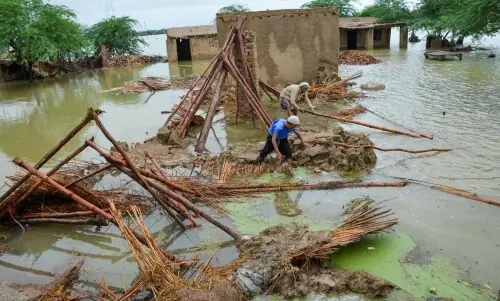
The frequent and heavy spell of rainfall in last few months and the heat wave in Karachi only show how seriously the problem of climate change is.
“The rich countries have benefited from industrial development but all at the cost of environment that poor vulnerable countries like Pakistan are now paying. It is imperative that the rich countries spend some of that money to conserve environment and help Pakistan adapt to the altering climate, which it cannot achieve on its own for lack of resources,” the minister said.
Published in Dawn, June 25th, 2015
On a mobile phone? Get the Dawn Mobile App: Apple Store | Google Play