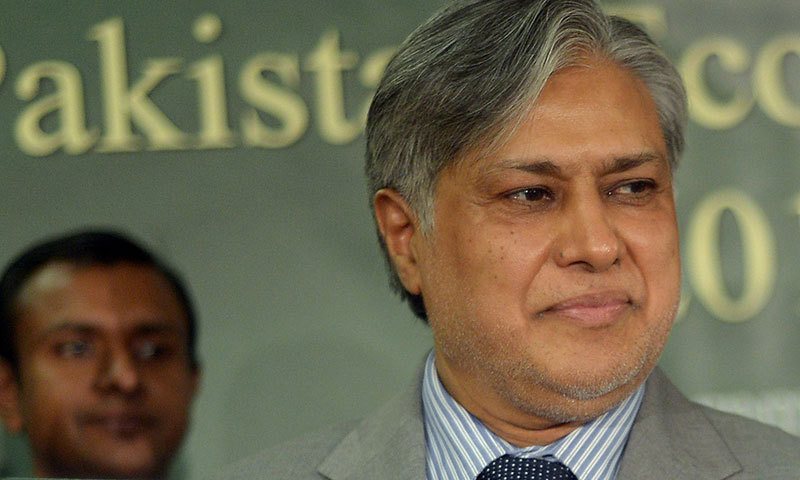


FINANCE Minister Ishaq Dar’s growth agenda for the remaining tenure of the PML-N government seems to draw strength from the expected kick-off of the $46bn worth of energy and construction projects through loans and investments under the China-Pakistan Economic Corridor.
Most of the incentives, provided through tax relief and other measures, appear to revolve around industries and sectors related to major ‘big push’ initiatives in many decades alongside facilitations for exports that went down 3pc this year against last year as manufacturing sector generally remained sluggish.
Apart from direct investments from the public kitty, incentives were announced for private sector investments in public-private partnership mode and tax relief was targeted for real estate and construction to facilitate CPEC projects. “We are proud of this flagship [CPEC] project that will transform Pakistan’s economy,” the finance minister said.
At the same time, incentives and investments were announced for energy-related projects, and the government reiterated its promise to end load-shedding by December 2017. “Energy is one of our key priorities,” said Dar, adding that the prime minister himself was devoting considerable time to oversee developments in this sector.
To support around 11,000MW in additional generation coming up under the CPEC, the government has introduced an initiative to attract private investment in transmission projects
A major part of the public sector investment — almost Rs500bn, including the PSDP and autonomous corporations — would be directed at communication and energy projects during next year. The completion of 7,000MW worth of new power projects in 2016 and for 3,600MW in 2017 would be of critical importance, along with wind, solar and hydropower projects like the Diamer-Bhasha and Dasu dams in the longer run.
And keeping the end of its tenure in 2017-18 in mind, the PML-N government has also designed a three-year medium-term macroeconomic framework. Economic growth has been forecasted at 5.5pc and gradually expected to rise to 7pc by 2017-18.
Meanwhile, taking advantage of the low inflation environment, the central bank has reduced the discount rate to a low of 7pc, as private sector credit plummeted to just Rs165bn this year from the previous year’s over Rs300bn.
Around Rs185bn were allocated for the construction of roads, highways and bridges — an increase of around 65pc over the ongoing fiscal. The continuation of signature infrastructure projects like the Karachi Metro Transit and some critical portions of the Karachi-Lahore Motorway also got a special focus in the next year’s budget.
Recognising the poor condition of the electricity transmission network and the lack of investments available in the public sector to support around 11,000MW in additional generation coming up under the CPEC, the government has introduced an initiative to attract private sector investment in electricity transmission line projects.
Profits and gains derived from transmission line projects have been exempted from taxes for a period of 10 years, provided that they are set up by June 30, 2018.
The government also introduced a new tax credit scheme while keeping in mind that some public sector power companies would require funds from the market for strategic asset improvement before their privatisation; the scheme would be available to other sectors as well.
For this, the government has offered to increase the limit of tax credit for investments made in shares offered by a public listed company to Rs1.5m from the existing limit of Rs1m.
The value-addition tax on commercial imports of all export-oriented sectors has also been reduced from 2pc to 1pc, with 100pc sales tax adjustment.
Special incentive packages have been announced for construction, agriculture, manufacturing and employment-generation sectors to kick-off economic growth because of their quick returns, labour-intensive nature and short gestation periods. The construction industry alone has a ripple effect on 16 other sectors of the economy.
The budget has proposed that mark-up on housing loans obtained by individuals from banks and other institutional lenders for the construction or purchase of a house be allowed as a deduction against income up to 50pc of taxable income or Rs1m.
The minimum tax on builders for the construction and sale of residential and other buildings has also been exempted until June 2018.
To encourage a corporatised and organised housing sector, the government has also encouraged real estate investment trust (REIT) schemes. Under this, the capital gains of any person,who sells a property to a REIT formed for the development of the housing sector, would be exempt from income tax till June 30, 2018.
Also, if a REIT scheme is set up by June 2018, the income tax rate charged on its dividend income would be reduced by 50pc for the first three years.
Similarly, the supply of bricks and crushed stone would be exempted from sales tax for the next three years to facilitate the construction sector.
Moreover, the customs duty has been reduced from 30pc to 20pc on the import of dump trucks, super swinger truck conveyors, mobile canal lining equipment, transit miners, concrete placing trucks, truck-mounted cranes and used crane lorries by registered construction companies.
However, the prime minister’s amnesty scheme that stipulated no questions be asked about the source of investment in greenfield industrial undertakings — announced over a year ago — has been extended until June 30, 2017, despite doubts about its real success.
Published in Dawn, Economic & Business, June 8th, 2015
On a mobile phone? Get the Dawn Mobile App: Apple Store | Google Play