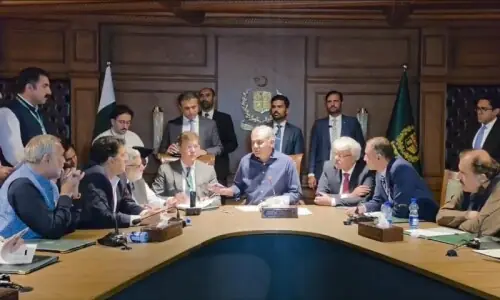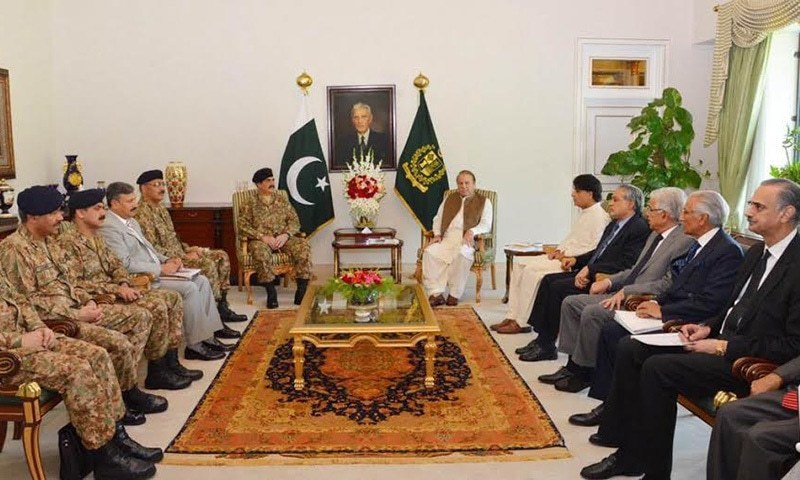


A REVIEW by the country’s political and military leadership of the progress made under the National Action Plan has resulted in an unsurprising though troubling admission: in key areas of NAP, the government has accepted that implementation has been far from satisfactory.
Consider the areas in which implementation was found particularly unsatisfactory: foreign funding of seminaries and terrorist groups; proscribed organisations and sectarian groups; hate speech; and madressah reforms.
Taken together, those areas amount to the very foundations of the terrorist and extremist complex.
Know more: PM chairs meeting to review Zarb-i-Azb, NAP
If funding, indoctrination and organisational capacity are left untouched and the focus is on finding, capturing and eliminating terrorism, it can be reasonably assumed that a new, smarter, more sophisticated generation of terrorists will emerge, a generation that will have adapted in order to survive and thrive.
So the failures identified in the implementation of NAP at the high-level meeting nearly amount to a failure of NAP itself. There is much left to be done clearly.
However, even with the relative successes that were identified — the military-led Operation Zarb-i-Azb in North Waziristan Agency and so-called intelligence-based operations against militants in the cities — there is a question mark over how those assessments have been reached.
To be sure, some parts of North Waziristan have been cleared of militants — but is there a strategy to consolidate those gains? If there is, it has not been apparent in the other agencies where large-scale operations have been conducted.
And while the number of terror attacks in the cities are down, the Safoora Goth carnage in Karachi has demonstrated the capacity of the terror network to continue to launch devastating strikes.
Furthermore, there is the old and seemingly intractable problem of the civil-military imbalance. Can the army leadership realistically cajole the government into taking its NAP responsibilities more seriously when in the big decisions — launching Operation Zarb-i-Azb, sanctioning military courts and lifting the moratorium on the execution of terrorists to name a few — there is a perception that the civilian government has been dictated to by the military leadership?
Of course, none of the above absolves the federal and provincial governments of the display of desultory behaviour when it comes to doing their job of helping keep the country secure.
Sometimes, the disregard has verged on the perplexing. Consider that Interior Minister Nisar Ali Khan, the linchpin of NAP on the civilian side, had allegedly not been on talking terms with his boss, Prime Minister Nawaz Sharif, until a meeting this week.
How, even seasoned observers of politics here have wondered, was that an acceptable state of affairs, especially post-December and the Peshawar school attack?
Sadly, the prime minister appears to have allowed flagrant indiscipline to go unpunished. Where also were the provincial chief ministers in Wednesday’s meeting? Can NAP really be effectively implemented without having the provinces on board?
Published in Dawn, May 29th, 2015
On a mobile phone? Get the Dawn Mobile App: Apple Store | Google Play