6
6


THE annual spring offensive of the Afghan Taliban tends to ratchet up diplomatic tensions between Afghanistan and Pakistan.
This year, with the Pak-Afghan relationship seemingly on the mend, it had been hoped that what was expected to be the toughest fighting season yet for the Afghan National Security Forces would not turn into a spat between Pakistan and Afghanistan.
However, with the official Afghan Taliban declaration of the start of the spring offensive little more than a week old, those hopes have already been dented.
After the Afghan interior ministry’s spokesperson alleged that militants from Pakistan had crossed over into Afghanistan to join the spring offensive, the spokesperson for the Foreign Office struck back, denying the Afghan interior ministry official’s accusations and suggesting that the best course for both countries was closer cooperation and coordination. Therein lies the crux of the recent problem.
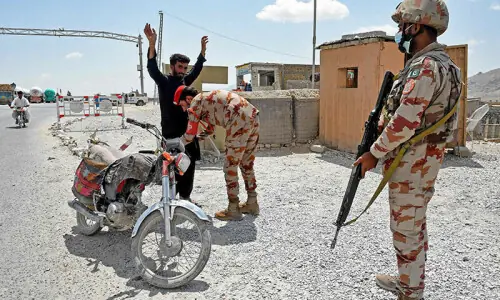
When Pakistan launched operations in North Waziristan and the Tirah region, the military here expected that anti-Pakistan militants would try and escape to Afghanistan and hoped that the Afghan state would either cut them off on the border or capture them inside Afghanistan.
Meanwhile, the Afghan government expected that Pakistan would do more along the Pak-Afghan border to prevent the Afghan Taliban’s spring offensive being reinforced by Pakistan-based militants, some of whom, having being eased out of their sanctuaries here, were always likely to join the fight in Afghanistan.
Neither the Afghan government’s nor the Pakistani state’s expectations have been responded to adequately by the other side, so now both countries are turning to an old and familiar blame game.
The best response is indeed closer cooperation and coordination, especially on border management, but the old issue of trust appears to be thwarting that.
There is also the much bigger issue of reconciliation inside Afghanistan that appears to be going nowhere — an impasse that is beginning to show in terms of the undiplomatic accusations Pakistan and Afghanistan are once again beginning to indulge in.
From the Afghan perspective, President Ashraf Ghani’s unprecedented outreach to Islamabad has not yielded the desired cooperation in terms of leveraging Pakistani influence over the Afghan Taliban to nudge them towards the negotiating table.
From the Pakistani perspective, despite Operation Zarb-i-Azb, Operation Khyber-II and the Peshawar school massacre, the Afghan state has not responded as urgently to Pakistan’s security concerns in its hour of need as it could have. Trust, as ever, appears to be the one commodity in short supply on both sides.
Published in Dawn, May 2nd, 2015
On a mobile phone? Get the Dawn Mobile App: Apple Store | Google Play