0
0
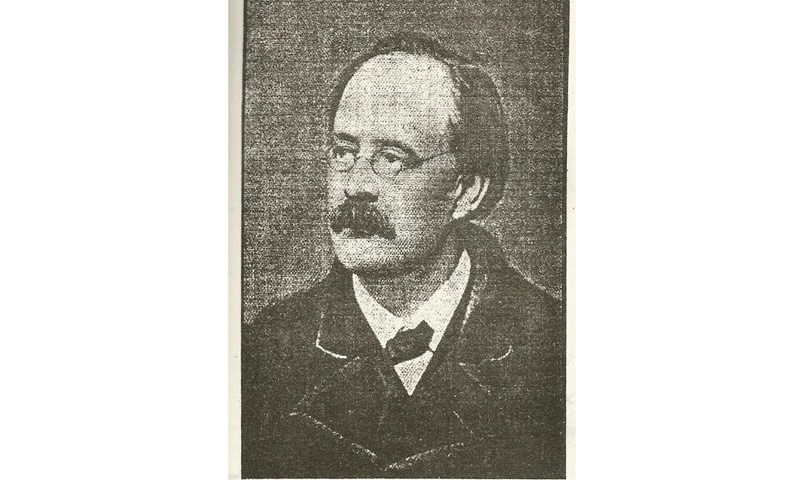

No history of educational institutions of the subcontinent can be complete without referring to Delhi College. Some great scholars had contributed to the progress of this 19th-century non-religious educational institution established in Delhi. Aloys Sprenger (1813-1893) was one of them.
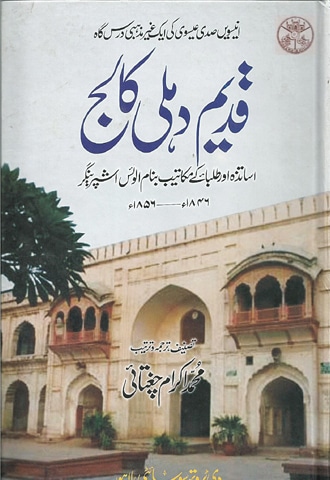
Delhi College was among the few institutions that not only imparted scientific and technical knowledge but also published some of the earliest Urdu translations of English books on science and technical subjects, using them as textbooks. Despite its importance, it has largely been ignored by researchers of Urdu and little material is available in Urdu on Delhi College and its translations. Maulvi Abdul Haq’s book Marhoom Delhi College is among these few sources. But a new book on Delhi College by Muhammad Ikram Chaghatai has brought to light some aspects of the life of Aloys Sprenger and of Delhi College hitherto largely unknown. Titled Qadeem Delhi College the book includes rare letters addressed to Sprenger by teachers and students of the college.
 |
Chaghatai has penned a detailed introduction to the book, which carries invaluable information on the college, Sprenger and his collection of rare oriental manuscripts. According to Chaghatai, Sprenger’s full name was Aloys Ignatz Christoph Sprenger. This renowned Orientalist was born on September 3, 1813, in a small town in Tirol, a province in Austria. At the Vienna University he studied medicine and later learnt Latin, Hebrew, Arabic and other oriental languages. He tried to start a career in teaching and translation but could not succeed. In 1838, he moved to England and penned a dissertation in Latin on ancient Arab medicinal practices. In those days, the Royal Asiatic Society had begun a research project on ancient Arab military sciences. Sprenger worked as secretary to the Earl of Munster, who was president of the society, and wrote a detailed and illustrated report in the Arabic language with the help of sources that also included works in Arabic, Persian and Turkish.
With the death of the Earl in 1842, the project was shelved. In 1843, Sprenger was selected as a medical doctor for the military and reached Calcutta (now Kolkata) in that capacity. When higher-ups knew of his abilities as a scholar of Arabic and oriental knowledge, they appointed him as the principal of Hooghly Mohsin College, West Bengal. In those days, Felix Boutros (1806-1864), another orientalist, was the principal of Delhi College. Due to ill health, Boutros resigned from this post and on March 19, 1845, Sprenger was made the principal of Delhi College.
According to Maulvi Abdul Haq, Nawab Ghaziuddin Khan Feroz Jang had established a madressah, or a school for religious teachings, in Delhi in 1792. It used to educate the students in traditional ways and the syllabi included Arabic, Persian, Islamic jurisprudence and other religious disciplines. In 1824, the British East India Company approved a budget for it and in 1825 the madressah was converted into Delhi College. In 1828, when it was reorganised and renamed as Anglo-Arabic College, English language classes were introduced. Though initially both Hindus and Muslims opposed the teaching of English for fear of students being converted to Christianity, in 1831, the number of students learning English reached 300.
Delhi College had two sections: an oriental section, where Arabic, Persian and Islamic studies were taught; and an Anglo-vernacular section, where modern western sciences were taught. One of the most important aspects of Delhi College, as Maulvi Abdul Haq has put it, was that the medium of instruction was Urdu. Scholars such as Maulana Imam Bakhsh Sehbai, Maulvi Mamlook Ali, Maulvi Subhan Bakhsh, Master Pyare Lal Ashob, Maulvi Zakaullah, Munshi Kareemuddin and Master Ram Chander were teachers at Delhi College. The British had asked Mirza Asadullah Khan Ghalib and Momin Khan Momin, two great poets of the time, to teach Persian at Delhi College but both refused for one reason or the other. The Delhi College alumni included names as great as Maulvi Nazeer Ahmed and Muhammad Hussain Azad.
The Delhi College Vernacular Translation Society did a remarkable job by translating over 100 works on scientific knowledge into Urdu. Felix Boutros played a very vital role in these translations. After him, Sprenger continued the splendid work. He launched a journal from the college, named Kiran-us-Sadain. Later, Master Ram Chander launched two more journals, named Fawaid-ul-Nazarin and Mohabbe-Hind.
Ikram Chaghatai has given a brief life-sketch of Sprenger in his intro. According to him, Sir Henry Miers Elliot (1808-1853), a historian and civil servant working with the East India Company, was an admirer of Sprenger and looking at Sprenger’s knack for manuscripts and his love for eastern languages and literature, Elliot got him posted as extra assistant-resident at Lucknow to prepare a detailed list of the libraries of the rulers of Oudh. At Lucknow, for about two years, Sprenger catalogued thousands of Arabic, Persian, Turkish and Urdu manuscripts. In 1850, he returned to Delhi to run Delhi College again as principal but was made principal of Madrasah-e-Alia, Calcutta. At Calcutta, he also served as secretary of the famous Asiatic Society of Bengal. In 1854, he embarked upon a long journey and spent about two years in the Middle East. Visiting many countries, he bought a large number of rare manuscripts. Sprenger finally settled down in a town near Heidelberg, Germany. He sold his immensely valuable collection of rare manuscripts to the Royal Library of Berlin. For a brief period he also taught Hindustani (or Urdu) at Switzerland’s Bern University. Sprenger died on December 19, 1893.
The research work that Sprenger published is amazing. It includes English translation of Al-Masudi’s Marvaj-az-Zahab; abridged and corrected edition of Al-Masudi’s work (in collaboration with Maulana Mamluk Ali); Utbi’s Tareekh-e-Yameeni (edited in Arabic); Gulistan-e-Saadi (edited in Persian with vowel marks); catalogue of the Arabic, Persian and Hindustani manuscripts of the libraries of the king of Oudh; a catalogue of the Bibliotheca Orientalis (catalogue of Sprenger’s personal collection); Abdur Razzaq’s dictionary of technical terms of Sufism (edited in Arabic); Kashshaf-e-Istilahat-al-Funoon (edited in Arabic); Life of Muhammad, and many, many more. Ikram Chaghatai has given a complete list of Sprenger’s works in the book under review.
Published by The Truth Society, Lahore, the book includes a large number of facsimiles as well as transcriptions of letters written by teachers and students of Delhi College addressed to Sprenger. These letters along with other rare documents and photographs in fact recreate a portion of history that is largely forgotten. In one letter Sprenger wrote that he was learning Chinese, yet another of 23 languages that he knew.
PS: Muhammad Ikram Chaghatai is a Lahore-based scholar and is known for his meticulous research works on Aloys Sprenger and his collection, history of the subcontinent and Urdu literature. Chaghatai has to his credit over 20 books and has been associated with a number of prestigious institutions including the Urdu Science Board and Punjab University’s department of Urdu Encyclopaedia of Islam.
drraufparekh@yahoo.com
Published in Dawn, March 24th, 2015
On a mobile phone? Get the Dawn Mobile App: Apple Store | Google Play