WHETHER Shafqat Husain was a minor at the time he committed the offence for which he has been sentenced to death may be a matter of debate, at least for now; the fact that his confession was obtained after he was tortured for nine days in police custody is scarcely in dispute.
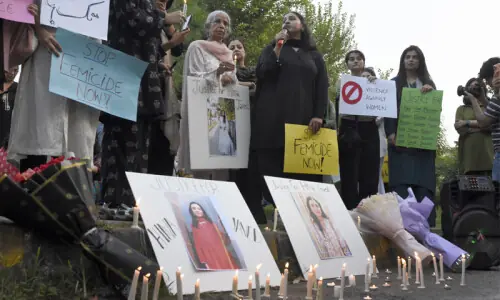
On Thursday, the lawyer for the main suspect in the Zahra Shahid murder case claimed his client had been subjected to torture by the police as a result of which he was passing blood in his urine.
Also read: SC assails ‘thana culture’
Dumped bodies of ‘missing’ people routinely display signs of sadistic treatment. Tellingly, an inordinate number of detainees — even young men — seem to suffer cardiac arrests during the criminal investigation stage.
Earlier this week, the Supreme Court was informed that two individuals at military-run internment centres up north had died of that very cause.
Sometimes the use of third-degree methods need not only be inferred. Who can forget the sight of the seven men — part of the so-called Adiala 11 — presented in court two years ago, their broken, tormented bodies testament to the torture they had suffered apparently at the hands of the intelligence agencies?
By engaging in such coercive methods to extract information/confessions or to intimidate individuals in custody, Pakistan violates not only the fundamental rights of its citizens as spelt out in the Constitution, but also its international commitments.
The country ratified the United Nations Convention Against Torture in 2010, which makes it binding upon Pakistan to pass relevant legislation that brings its law-enforcement apparatus in conformity.
However, both the country’s penal and criminal procedure codes remain conspicuously silent on the subject. While the Police Order 2002 does spell out sanctions for inflicting “torture or violence” on individuals in custody, in practice even those provincial police ostensibly operating under it — Punjab and Khyber Pakhtunkhwa — follow the archaic Police Act 1861.
A survey carried out in 2013 in Punjab found that nearly 55pc accused complained of torture in police custody. Meanwhile, intelligence agencies appear to operate according to rules of their own making.
It is worth recalling that according to a recent US Senate report, the “enhanced interrogation techniques” employed by the CIA against terrorism suspects in shadowy internment centres around the world yielded virtually no actionable intelligence.
Moreover, not only is the information extracted under conditions of torture unreliable, it exacerbates the brutalisation of society and fuels further disenchantment with the state.
Published in Dawn, March 21st, 2015
On a mobile phone? Get the Dawn Mobile App: Apple Store | Google Play