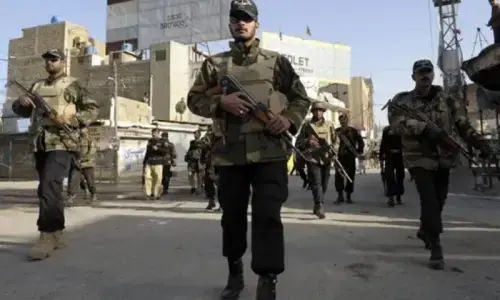
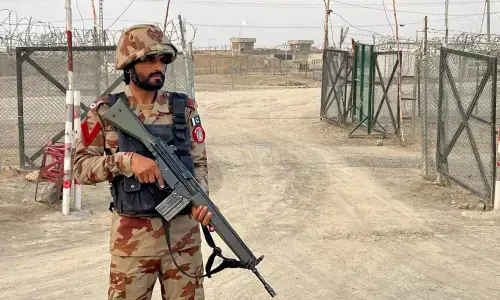
IN a strange, mostly unexplained twist, President Mamnoon Hussain has promulgated an ordinance further revising the recently amended Army Act to ostensibly aid the functioning of military courts by allowing for trials in camera, ie without the presence of the public or the media, and over video link if necessary.
The idea, according to a special assistant of the prime minister who handles legal matters, is to enhance security for presiding officers, military prosecutors, witnesses and defence lawyers by shielding their identity from the public and the media.
Take a look: Security for military court judges and prosecutors
While that may seem like a sensible idea — and only at first blush — it is quite incredible that already the law dealing with military courts is being amended in such a clandestine manner and without any debate.
The need for a presidential ordinance — a legislative tool that has been used in the past to undermine parliamentary democracy — points to either one of two problems.
Military courts were either mooted in haste and only now are the real-world impediments to their functioning becoming apparent, hence the need to tweak the law.
Or the government and the military which demanded such courts do not feel obliged to maintain any level of transparency in the operation of these courts and are now confident enough to introduce changes that essentially seal off their functioning from any kind of public and media scrutiny.
Consider the great irony of this latest presidential ordinance: if special courts and anti-terrorism courts had been given the same protections (in-camera proceedings and video links to protect identities of prosecutors, judges and witnesses), the same urgent resources and the same level of attention by the senior-most state functionaries, perhaps the need for military courts would not have been felt in the first place.
With this latest presidential ordinance, it appears that the government and military officials ultimately do want to create a parallel judicial system — a closed-off system of courts where public scrutiny is minimal, or even non-existent, and everything is justified in the name of the national interest and protecting the people.
That criticism is not unjustified. Military courts were mooted as a very narrow and very limited solution to a very serious problem: hardcore terrorists and terrorist masterminds who needed to be convicted and remain convicts in a broken criminal justice system.
Already though there are suggestions in various quarters, usually in response to an unforeseen and undesirable event, that the scope of military courts be expanded. Perhaps the senator who suggested getting military courts involved in the World Cup cricketing debacle of the Pakistani team was only being facetious or spoke in mock frustration, but it has already been seen how voices have called for military courts to deal with Karachi law-and-order woes.
Military courts must not become the new normal — and clandestine, unexplained changes to the law must be resisted.
Published in Dawn, February 26th, 2015
On a mobile phone? Get the Dawn Mobile App: Apple Store | Google Play