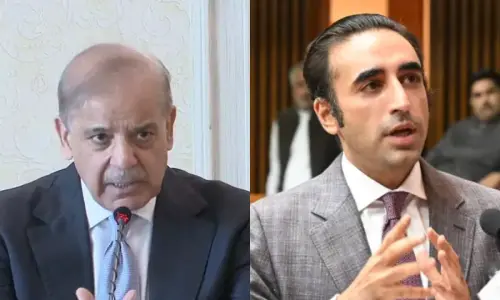
ISLAMABAD: The PPP leadership’s decision to go along with the government in amending the Constitution to pave the way for military courts came under severe criticism at a meeting of the party’s parliamentary party held here on Monday.
Sources said that although no one dared naming party’s co-chairman Asif Ali Zardari who announced support for the government’s move to establish military courts at the last week’s multiparty conference, a number of PPP legislators complained as to why they had not been taken into confidence before making the decision.
Know more: Military courts: Zardari helps bring about consensus
Prominent among those who spoke against the PPP leadership’s decision were Raza Rabbani, Nawab Yousuf Talpur, Taj Haider, Nafeesa Shah and Amir Magsi.
“What is the use of convening this meeting now,” Mr Talpur asked. Mr Talpur, an MNA from Sindh, remained vocal during the meeting jointly presided over by Syed Khurshid Ahmed Shah and Chaudhry Aitzaz Ahsan, Leaders of Opposition in the National Assembly and the Senate, respectively.
Mr Talpur was of the view that the parliamentary party’s meeting should have been convened earlier as now they had no other option but to vote for the bills in support of military courts after the leadership had already made a decision.
The sources said there was not a single voice in the support of the party leadership’s decision to support the proposed 21st Amendment Bill, 2015, and the law to amend the Army Act.
Interestingly, the meeting coincided with the 87th birth anniversary of the PPP’s founding chairman and former prime minister, Zulfikar Ali Bhutto.
The PPP legislators said they had no other option but to vote for the bills but requested the government to defer voting on the bills for a day or two because they did not want to approve the setting up military court on the birthday of Mr Bhutto who gave the country its Constitution in 1973.
The PPP’s parliamentary leader in the Senate, Raza Rabbani, termed it a ‘death day’ for parliament.
Later, while speaking on the floor of the Senate, Mr Rabbani read out Article 270-AA of the Constitution, saying parliament earlier had the honour of not validating illegal acts of military dictators in the past, “but now it is taking last breath”.
He was of the view that after the passage of the proposed 21st Amendment bill, the constitution would no more remain “pure”.
As Khurshid Shah preferred to keep silence in the parliamentary party’s meeting, Aitzaz Ahsan tried to pacify his colleagues by explaining some positive points of the draft bills.
He claimed that the PPP had succeeded in including some important clauses in the drafts to check political use of military courts. He told the legislators that the draft ensured that the law would not be used against nationalists and politicians. Similarly, he added, it was because of PPP’s efforts that the law would remain effective only for a limited period of two years.
Published in Dawn, January 6th, 2015
On a mobile phone? Get the Dawn Mobile App: Apple Store | Google Play