IN the end, our political leadership proved unable to defend the constitutional and democratic roots of the system or resist the generals’ demands.
Pakistan is to have military courts once again. To establish them the politicians have agreed to distort the principle of separation of powers, smash the edifice of rights upon which the Constitution is built and essentially give up on fixing decrepit state institutions.
Know more: MPC ends with national consensus on NAP
Yes, we need a coherent strategy to fight militancy and political and military leaders to work together. But military courts are not the answer.
First, let there be no doubt why the country must now prepare to live under the shadow of military courts: the military leadership wanted these courts.
Yesterday, the ISPR quoted army chief Gen Raheel Sharif as having told the multiparty conference in Islamabad that military courts “are not the desire of the army but need of extraordinary times”.
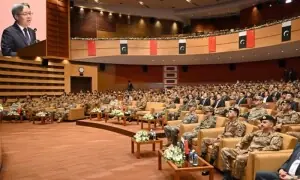
A day earlier, the ISPR quoted him as having told a corps commanders’ meeting that “bold, meaningful decisions” were needed to ensure “stern action vs terrorists, their sympathisers” and warned that the “much wider political consensus” should not be “lost to smaller issues”.
It is a sad time for democracy when an army chief so openly directs the political process.
Second, while it is parliament’s right to amend the Constitution and the idea of a basic structure to the latter was only given a fresh lease of life because of the tussle between parliament and the Iftikhar Chaudhry-led Supreme Court over the judicial appointment process, one hopes that in a democratic system parliament will not undermine civilian-run institutions, least of all to hand yet more power to an institution that has overthrown the Constitution several times in the past.
Also read: Military courts: How the reluctant were brought around
Consider that where previous constitutional amendments during civilian dispensations were designed to clear the mess left behind by military dictators, this time it is the civilians who will be muddying the document to empower the army further. The 21st constitutional amendment will stand as a monument to the betrayal of the civilian, democratic cause.
Third, nothing — nothing — has prevented the government or parliament from urgently strengthening the existing legal system and judicial process other than the government and parliament itself.
Had the same time and effort spent on winning consensus for military courts gone into urgent reforms and administrative steps to fix the criminal justice structure, the existing system could have been brought into some semblance of shape to deal with terrorism.
Sadly, the political leadership has abdicated its democratic responsibilities. Surrender perhaps comes easily.
Published in Dawn, January 3rd, 2015
On a mobile phone? Get the Dawn Mobile App: Apple Store | Google Play